Reply to a bad review within a day or two, keep it calm and short, thank the reviewer, say you are sorry they had that experience, and move the conversation to a phone call or email. Do that and you show every future customer how you behave when things go wrong. That matters because the next customer reads your reply as well as the complaint. At Business In Focus, we list verified Australian businesses, so we know how much a visible, professional reputation counts for a local service provider. This guide gives you the steps, the wording and the legal limits.
TL;DR
- Respond within 24 to 48 hours, but draft the reply calmly. Never reply while angry.
- Use a simple structure: thank, apologise for their experience, state you want to fix it, invite contact offline.
- Never argue, name staff, reveal customer details or admit liability before you check the facts.
- You cannot delete a genuine negative review. Under the Australian Consumer Law, removing or hiding genuine negative reviews to inflate your rating can breach the law.
- Use each bad review as feedback, fix the cause, and keep collecting honest reviews so one complaint never defines your rating.
Table of Contents
- Why your reply matters more than the review
- Before you type: slow down and check the facts
- A reply structure that works
- Templates for common situations
- What not to do
- Can you remove a bad review?
- Do good reviews cancel out a bad one?
- Turn the complaint into a fix
- A simple routine for managing reviews
- Build a reputation that carries a bad review
- FAQ
Why your reply matters more than the review
A bad review is a single moment. Your reply is a permanent record of your character. Business Victoria advises taking the high road and responding carefully and kindly, which can make a nasty reviewer look less credible to other readers.
The ACCC says a business that responds to negative reviews professionally is more likely to be viewed favourably by consumers. It also reports that some review removal services told clients not to respond publicly. The ACCC states that consumers’ opinions are influenced by how a business responds. Silence is not a safe option.
The Western Australian Commissioner for Consumer Protection puts it the same way: a calm, constructive reply to a genuine complaint shows other potential customers that you take customer service seriously.
Write for the person scrolling past at 9 pm deciding whether to call you. The reviewer is only a small part of your audience.
Before you type: slow down and check the facts
Business Queensland warns against responding immediately without stepping back. The official guidance on online reviews from business.gov.au agrees: respond promptly, but take time to draft a carefully written response.
Use this short checklist first:
- Find the job. Match the review to a real customer, booking or invoice. If you cannot, that shapes your reply (see the templates below).
- Gather the records. Sprintlaw suggests collecting invoices, receipts, booking confirmations, message history, photos and job notes, plus the refund or cancellation policy that applied at the time.
- Ask your team. Business Queensland advises speaking to staff as well as the customer so you have both sides of the incident.
- Decide the outcome you can offer. A return visit, a refund, a redo or simply a conversation. Know your limit before you reply.
- Sleep on it if you are angry. A day’s delay is better than a defensive paragraph that lives online forever.
Prompt does not mean instant. The sources differ on speed: government and small business guidance points to a day or two, and some trade-focused advice aims for a few hours. A good target is to acknowledge within one business day and resolve properly after that.
A reply structure that works
A safe structure, set out by Sprintlaw, has four parts:
- Thank the reviewer.
- Say you are sorry they had that experience.
- State that you want to resolve it.
- Invite contact by phone or email.
Here is an example for a tradie, written in our own words:
Hi Mark, thanks for taking the time to tell us about this. I’m sorry the job didn’t go the way you expected. I’d like to understand what happened and put it right. Could you call me on [phone] or email [address]? Dave, Owner
Why it works:
- A name and direct contact. It shows a real person is accountable.
- No detail about the job. You do not discuss prices, addresses or what was said on site.
- Short. Long replies look defensive and invite a back-and-forth thread.
- An apology for the experience, not an admission of fault. You can be sorry someone is unhappy without conceding liability before you have checked.
Business Queensland also reminds businesses that private messages can be shared and that everything online is effectively public, so keep your tone professional in every channel, including the inbox.
Make it sound like a person
Ten identical “Thanks for your feedback!” replies look automated. Use templates as a starting skeleton, then add one specific detail from the complaint, such as the day, the delay or the missed callback, without revealing private information. Vary your wording and keep each reply short.
Templates for common situations
The right reply depends on what kind of review you are facing. These are starting points. Adjust them to your voice and never paste them untouched.
| Situation | What to do | Sample wording |
|---|---|---|
| Genuine service complaint | Thank, apologise, offer to fix, take it offline | “Thanks for letting us know. I’m sorry we fell short. I’d like to make this right. Please call me on [phone].” |
| Late or overrun job | Own the communication gap, offer a specific step | “We should have kept you updated better. I’d like to talk about how we can make up for it. Please email [address].” |
| Left a mess | Offer a return visit | “I’m sorry the site wasn’t left as it should be. We’d like to arrange a time to come back and sort it. Please contact [phone].” |
| Complaint about a staff member | Never name them or say who was working. Do not defend or blame publicly | “Thanks for the feedback. We take it seriously and will look into it. Please email [address] so we can talk it through.” |
| Facts are wrong | Correct the record once, calmly, without calling anyone a liar | “We want to make sure the details are clear. Our records show [brief non-sensitive fact]. If we’ve missed something, please email [address].” |
| Can’t find the customer | Say you have no matching record and invite contact | “We haven’t been able to match this to a recent job. If we’ve got something wrong, please contact us at [address].” |
| Abusive language | Stay calm, do not mirror the tone | “We’re sorry you feel this way. We’re happy to discuss your concerns directly at [address].” |
| One star, no text | Acknowledge the rating, show concern, invite contact | “Thanks for your rating. We’re concerned to see it and would like to hear what went wrong. Please contact us at [phone].” |
The patterns in this table follow what Australian small business guides recommend. Cyberry’s guidance for hospitality advises never naming staff and saying nothing more than that individual incidents cannot be discussed publicly when someone was refused service. For a review you do not believe is genuine, the advice is to say you cannot match it to a visit, not to accuse the reviewer of faking it.
A note on price complaints
If the complaint is about cost, explain the reason briefly and respectfully, without lecturing. Hospitality guidance such as Calso’s templates shows owners explaining that penalty rates apply on public holidays. Keep it to one sentence and then invite them to talk.
What not to do
Avoid these, drawing on Sprintlaw’s list and Business Queensland’s guidance:
- Disclosing personal or transaction details in public.
- Accusing or threatening the reviewer.
- Replying emotionally or sarcastically.
- Admitting liability before you have assessed what happened.
- Creating a long public thread.
- Writing fake reviews or using review sites to tarnish a competitor.
- Giving rude or aggressive responses.
Also do not make a refund conditional on the customer changing their review. If you resolve the issue, it is fine to politely ask whether they would consider updating it, but never demand it. The official advice from business.gov.au is to follow up after resolving the issue, as the customer may be willing to update the review.
Can you remove a bad review?
Only in limited cases. Sprintlaw explains that in Australia a business cannot delete reviews left by customers. Google controls removal. You can report a review that breaches Google’s content policies or Australian law, but you cannot press a delete button yourself.
aGoogle does not remove a review just because it is negative or you disagree with it. Removal applies to things like spam or fake reviews, conflicts of interest, off-topic content, harassment or hate speech, and impersonation.
To report a review on Google:
- Open your Google Business Profile and go to the Reviews tab.
- Use the three-dot menu on the review and select Report review.
- Choose the specific reason that applies.
- If needed, submit a formal request with evidence such as booking records and screenshots, and keep the case number for follow-up.
For suspected fakes, the WA Commissioner advises contacting the platform, identifying the reviews you believe are fake, explaining why with evidence, and considering a reply to correct the public record.
The legal line
The ACCC states that creating fake reviews, or editing or removing genuine negative reviews to inflate your own ratings, lower competitors’ ratings or hide genuine negative reviews, breaches the Australian Consumer Law. It also notes that a negative review may not be fake even if it looks that way, so the right move is to reply and reach out to the customer rather than assume it is fake.
Sprintlaw adds that selectively publishing only positive reviews can create a false impression and risk breaching the general prohibition on misleading conduct in section 18 of the Australian Consumer Law. If a review is genuinely defamatory and causing real harm, speak to a lawyer before taking any action.
Do good reviews cancel out a bad one?
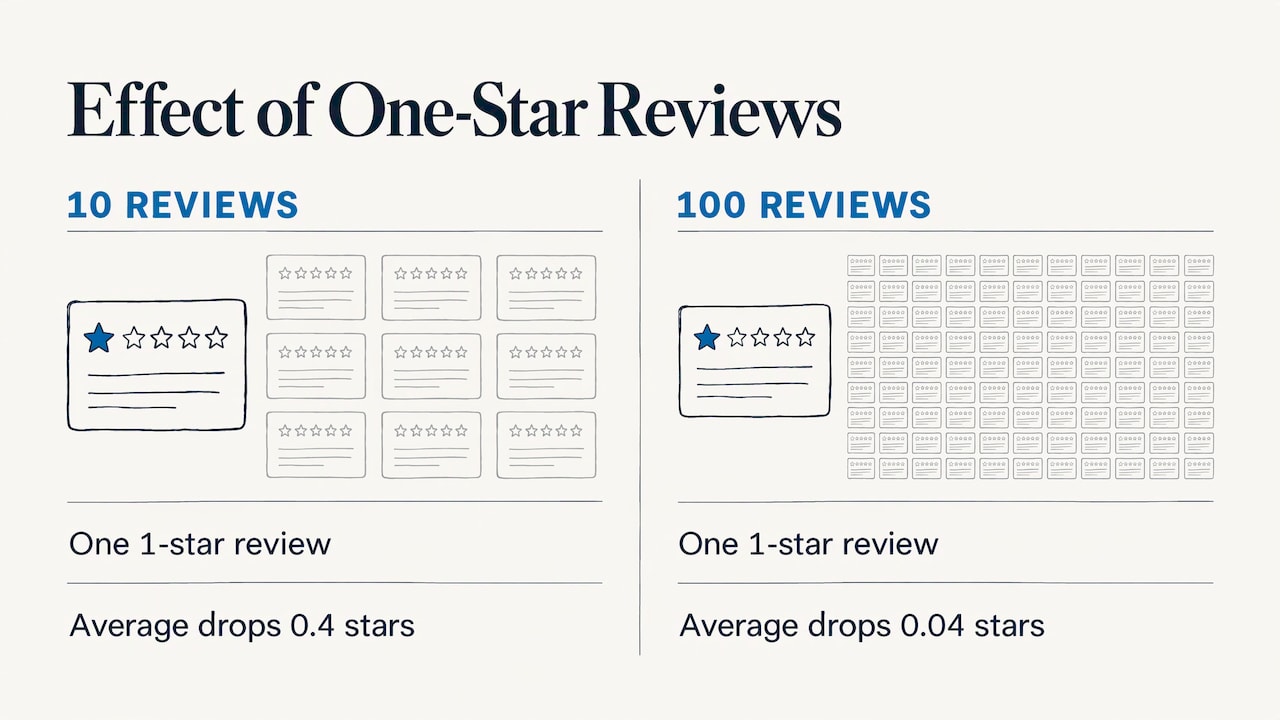
They dilute it, and the maths is on your side as your review count grows. According to one review platform’s explanation, a single 1-star review among 10 total reviews pulls the average down by 0.4 stars, while among 100 reviews it moves it by only 0.04. Each review counts equally regardless of age.
The practical lesson is to keep a steady flow of honest reviews coming. Local Falcon notes that consistent collection matters more than chasing a fixed number, and that a business with about 50 reviews may need 10 to 20 new positive ones to lift its average by a decimal point after a low score.
But collect reviews the right way. Google’s content policy, as summarised by Clue, prohibits offering incentives such as discounts or gifts for reviews, review gating (only asking happy customers), and fake reviews. Violations can lead to review removal, suspension of your Business Profile or being blocked from receiving new reviews. A good approach is to send a request by SMS or email after the job and ask for an honest experience, not a particular star rating.
Turn the complaint into a fix
A good reply only works if the problem is actually dealt with. Business Queensland’s complaints guidance suggests the L.E.A.R.N. model:
- Listen to the customer.
- Empathise with their situation.
- Ask what outcome they would like.
- Reassure them that steps will be taken.
- Never forget to follow up and thank them.
The same guidance recommends appointing one staff member promptly, authorising them to organise solutions within agreed limits, focusing on a solution the customer approves, acting quickly, and telling the customer what will be done to prevent it happening again.
Business.gov.au also recommends analysing feedback themes across your reviews, choosing which areas to improve, and telling customers about the changes you have made. If three reviews in a quarter mention missed call-backs, the fix is a call-back process, not a better reply template. A year later, a reply such as “we’ve changed how we schedule jobs since your feedback” is far more convincing than an apology.
A simple routine for managing reviews
Business Queensland recommends identifying the sites where you most often get reviews, claiming your business pages, reading each site’s participation rules, turning on notifications, setting up Google Alerts, deciding who responds and setting rules for those responses. Staff who reply should be trained in customer service, in writing in your brand’s style, in what complaint resolution they can offer, and in when to pass a review to a senior person.
A workable weekly rhythm for a small team:
- Monday: check all platforms and alerts, and flag anything needing a response.
- Daily: a five-minute check of your main review channels. Acknowledge anything negative within a day or two.
- Midweek: write thoughtful replies to new reviews, positive ones included. A profile where the owner replies to everything signals a business that is paying attention.
- Friday: send a few personal review requests to customers whose jobs went well.
- Monthly: list the complaint themes and decide on one improvement.
Write a short internal rule sheet: who replies, which outcomes they can offer without approval, and which reviews go to the owner. That keeps your tone consistent when you are busy or on leave.
Build a reputation that carries a bad review
A single complaint hurts most when it is the only thing a stranger can find about you. Local service providers do better when their reputation is visible in more than one place: reviews, a credible profile and a clear description of how they work.
Business In Focus is a curated directory of verified Australian businesses in sectors such as plumbing, electrical, cleaning, pest control and chiropractic. We select listings on verified credentials, reputation and service performance, and quality cannot be bought through promotions. Each business profile is professionally written, reviewed and placed on a targeted landing page. Listings are an annual fee: Basic is $99 per year, Pro is $199 per year and Agency is $449 per year. You can see the details on our business listing plans.
You can also see how a feature page reads in our listings archive, which shows how local businesses are presented to homeowners.
FAQ
How do I politely respond to a negative review?
Thank the reviewer, say you are sorry they had that experience, state that you want to resolve it and invite them to contact you by phone or email. Keep it short, avoid defending yourself in public and leave out private details. A named owner with a direct contact shows accountability.
How quickly should I reply?
The common guidance from Australian small business sources is within 24 to 48 hours, and some trade advice aims for hours. Take enough time to check the facts and write calmly. A prompt, considered reply is better than a fast, angry one.
Can I get a bad review deleted?
Not simply because it is negative. Google removes reviews that breach its content policies, such as fake, spam, harassing or off-topic content, and you can report them through your Business Profile. Removing or hiding genuine negative reviews to improve your rating can breach the Australian Consumer Law.
How many positive reviews does it take to cancel out a negative one?
It depends on how many reviews you have. One 1-star review among 10 lowers your average by 0.4 stars, but among 100 it lowers it by only 0.04. Keep collecting honest reviews steadily, without incentives or gating.
Should I respond to a review I think is fake?
Yes, calmly. Say you cannot match it to a recent job and invite the reviewer to get in touch, without accusing them. Report it to the platform with evidence. The ACCC notes a review that looks fake may be genuine, so replying and reaching out is safer than assuming.