An online business listing is a profile of a business on a website where people go to find local services: a name, an address or service area, a phone number, a description and, ideally, reviews. For homeowners, the best listing is one that has been checked by someone other than the business itself. For business owners, the best listing is one that shows your credentials in full on a page people trust. That is how we built Business In Focus: a curated Australian directory where quality is selected, not bought through promotions, and where each business profile is professionally written and reviewed.
This guide covers both sides. If you are hiring a plumber, electrician or cleaner, it shows you how to read a listing and what to look for behind it. If you run a local business, it shows what a strong listing contains, how to keep your details consistent and how to tell whether a listing is worth having.
TL;DR
- An online business listing is a public profile of a business: name, location or service area, contact details, services and usually reviews.
- Homeowners should treat a listing as a starting point and check the business itself. The ACCC says registration numbers and business cards do not prove a business is genuine, and that reviews should be read from more than one source.
- A curated directory does part of that checking for you, because the vetting happens before a business appears.
- Business owners should keep their name, address and phone details identical everywhere and keep hours and contact information current.
- Business In Focus listing plans cost $99 (Basic), $199 (Pro) and $449 (Agency) per year.
Table of Contents
- What an online business listing is, and what it contains
- For homeowners: how to judge a listing before you call
- Why curated listings read differently
- For business owners: what a strong listing does for you
- How to choose where to be listed
- Business In Focus listing plans
- How to tell whether your listings are working
- Common mistakes with online listings
- FAQ
- Sources
What an online business listing is, and what it contains
Think of a listing as the digital version of a shopfront sign plus a reference. It sits on a directory, a map service or a review site, and it answers the first questions a customer has: who are you, where do you work, how do I reach you and what do you do.
Most listings carry the same core details:
- Business name, as it is actually trading.
- Address, or the suburbs served. Trades that travel to the customer, such as electricians and cleaners, usually list a service area instead of a shopfront.
- Phone number, email and website.
- Categories and services, for example emergency plumbing or end-of-lease cleaning.
- Opening hours, including public holidays.
- Photos and reviews.
The difference between listings is not the fields. It is how much work stands behind them. A basic listing is a form the business filled in. A curated listing has been assessed, written up and placed where customers browsing a particular trade and place will find it.
For homeowners: how to judge a listing before you call
A listing makes a business easy to find. It does not make it good. Scammers and careless operators can also build a tidy profile, so a few checks are worth the five minutes they take.
Do not rely on identification alone
The ACCC, Australia’s consumer regulator, warns that business cards, registration numbers and similar identification do not necessarily prove a business is legitimate, and that scammers can fake registration numbers. Its advice is to check the business using online tools and to read reviews from several places, not only the business’s own website or social media.
A short routine that works
Using the ACCC’s guidance as the base, here is a practical routine for a tradie or service provider you have never used:
- Look the address up on a map. A listing with a street address should lead to a real premises or a plausible base, not an empty lot.
- Read the website address carefully. Odd domain names, missing policies or no complaints information are warning signs, as is an insecure payment page.
- Compare reviews across sources. A business with glowing reviews in only one place, all posted in the same week, deserves more questions.
- Check licences where your state requires them. Plumbing, electrical and some other trades must be licensed, and your state or territory regulator is the place to confirm it.
- Get a written quote before work starts.
Ask what the directory itself checks
The same question applies to the site hosting the listing. The UK government’s guidance on trader recommendation sites is a useful framework even for Australian readers, because the questions are universal. It suggests asking what vetting a site actually does: whether it verifies identity, experience, qualifications, licences and insurance, how often it re-checks them, whether reviews come from verified customers and whether there is a clear complaints process. It also suggests comparing several traders rather than taking the first result.
Those are the questions a curated directory exists to answer before you ever see a listing. Business In Focus features businesses selected on verified credentials, reputation and service performance, and it does not take payment to rank anyone higher. You can see how that looks in practice on our directory of trusted local services, or go straight to a trade such as electricians, plumbers or house cleaning.
A worked example
Say your hot water system fails on a Sunday and you need a plumber in Sydney. A search returns a dozen listings. Two minutes of reading will do most of the sorting:
- Discard any listing with no address or service area and only a mobile number.
- Keep listings whose name, suburb and phone match across the directory and the business’s own site.
- Open the written profile. Does it describe the services, the area and the credentials in specific terms, or is it three generic lines?
- Read two or three reviews from different places. Look for detail (what was fixed, how long it took, how the price compared with the quote) rather than adjectives.
- Call the shortlisted two and ask for a quote in writing.
On a curated site, the first filtering has already happened, so your shortlist starts from businesses that passed a standard. Our guide on finding trusted plumbers goes deeper on one trade.
Why curated listings read differently
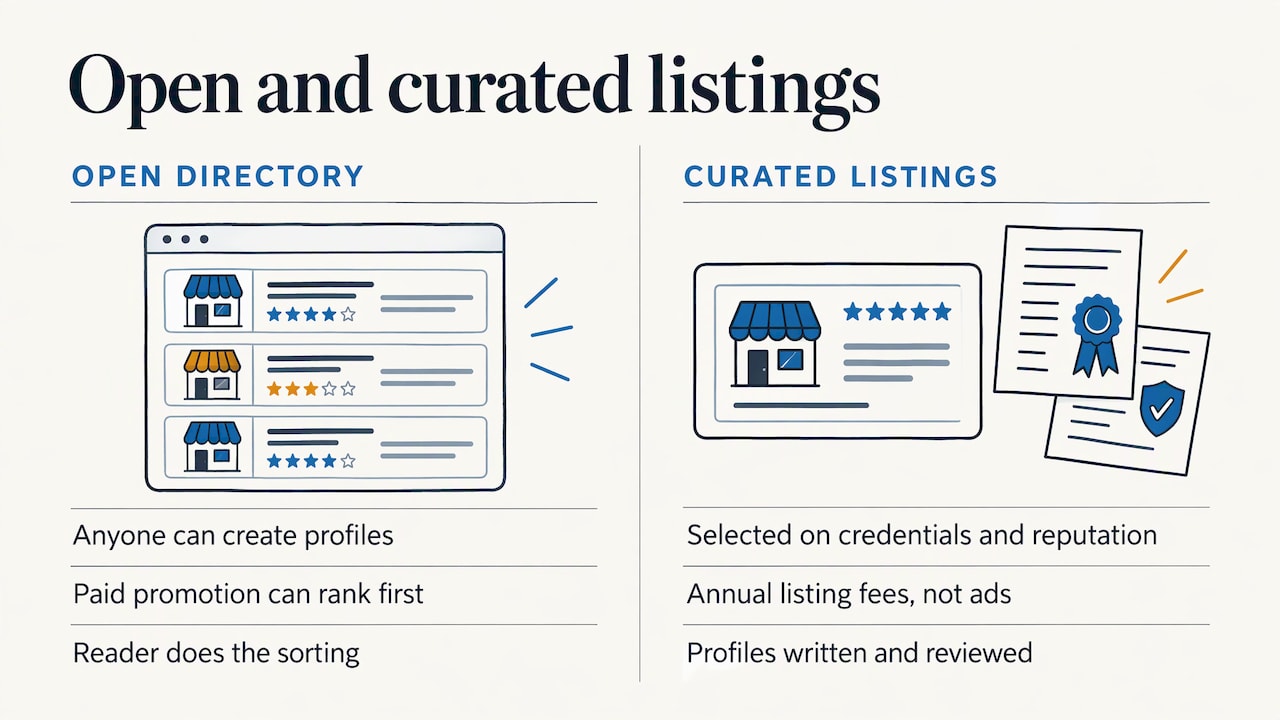
In an open directory, anyone can create a profile in minutes. That is good for coverage and poor for trust, because the reader has to do all the sorting. Paid promotion adds a second problem: a business can appear first because it paid, not because it is better.
Business In Focus works the other way. Our income comes from annual listing fees paid by local businesses for professionally written feature pages, not from advertising or affiliate links, and we select listings on credentials, reputation and service performance. A business profile is written and reviewed by us and placed on a targeted landing page. The result is a page with enough substance for a homeowner to make a decision, such as our reviews of Link Plumbing or Hello Electrical. You can browse everything in the listings archive.
For business owners: what a strong listing does for you
Customers decide quickly, and much of that decision rests on what they can verify. Tourism Australia, writing for operators, notes that travellers are much more likely to trust a business with positive Google reviews, that reviews also help search ranking and that a respectful reply to a negative review can add to perceived trustworthiness. The same logic holds for a homeowner choosing an electrician: visible proof, in more than one place, lowers the risk of picking you.
A listing does three jobs for a local business:
- It makes you findable when someone searches for your trade and area.
- It gives you a page you control to explain what you do, where and with what credentials.
- It borrows credibility from the place that hosts it. A listing on a site that turns businesses away says more than a listing on a site that accepts everyone.
That third point is why we select rather than accept all comers. A business appearing on Business In Focus has been assessed, and a customer reading its page knows it.
Keep your details identical everywhere
Whatever directories and maps you appear on, the basics need to match. Tourism Australia advises matching your business name exactly to your website, keeping contact details, opening hours and public holiday availability current and replying to every review. Practically, that means:
| Detail | What to do |
|---|---|
| Business name | Use the same trading name on your website, your invoices and every listing. No added keywords or suburbs. |
| Address or service area | Use one format throughout. Pick “Street” or “St” and stick with it. Service businesses should list the suburbs they cover. |
| Phone number | One main number, in one format. |
| Website | One address, pointing to a page that works on a phone. |
| Hours | Update for public holidays and busy seasons. |
| Services | Same wording and same categories wherever you can. |
When you change anything, such as a new number or a moved depot, update every listing the same week. Inconsistent details confuse customers first and search engines second.
Watch for changes you did not make
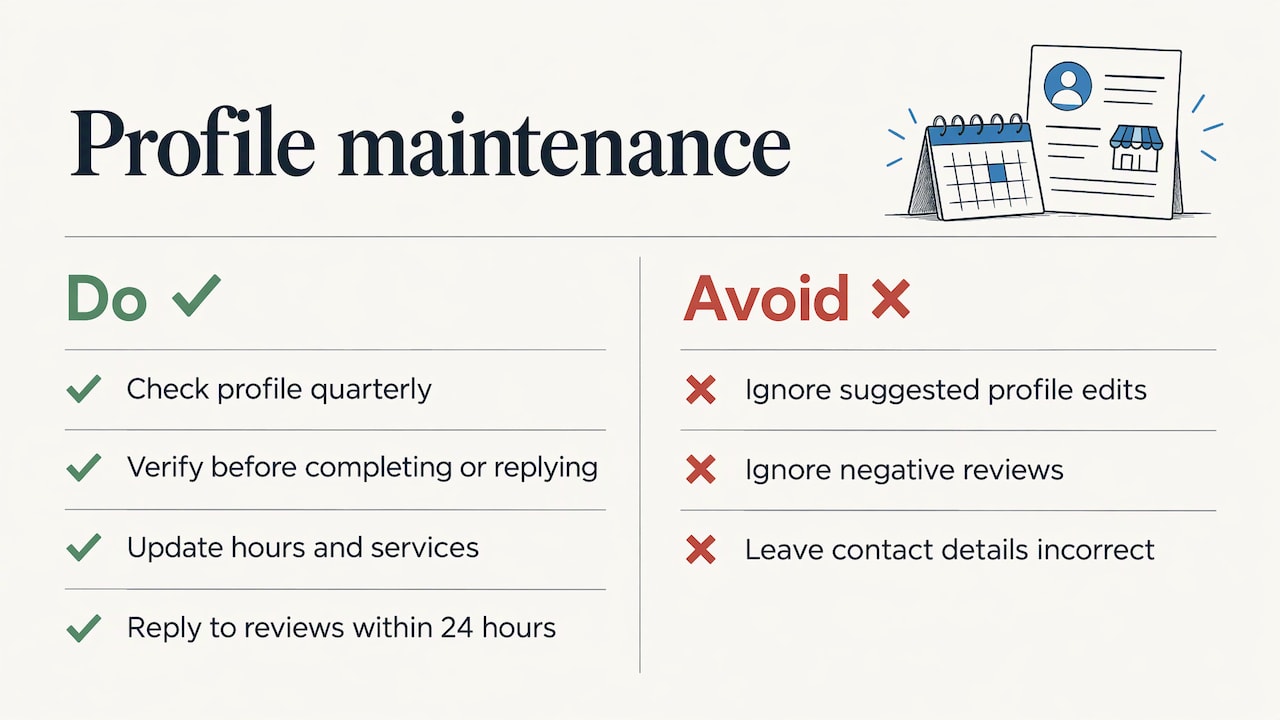
Some open platforms let other people suggest edits to your profile. The Western Australian small business centre warns that anyone with a Google account can suggest an edit and the change may be published without your knowledge, so you should check your profile regularly and respond to reviews, including negative ones. It also notes that a profile must be verified before it can be completed or used to reply to reviews. Put a quarterly check in your diary.
One local council’s online health checklist for small businesses sets out a similar routine: correct name, address, website and contact details, good photos, regular updates to hours and services, and monitoring reviews, ideally replying within 24 hours.
How to choose where to be listed
Not every listing is worth the same. Before you pay for or spend time on one, run it against these criteria:
| Question | Why it matters |
|---|---|
| Does the site select who appears? | A curated site tells customers you passed a standard. |
| Is the profile written in detail? | A page that explains your services and credentials answers customer questions before they call. |
| Does it cover your trade and area? | A listing is only useful where your customers are searching. |
| Is ranking driven by payment? | If it is, your credibility depends on your budget, not your quality. |
| Is the cost clear and annual? | A flat yearly fee is easy to weigh against the work it brings in. |
Business In Focus meets each of these. Listings are selected on verified credentials, reputation and service performance, profiles are professionally written and reviewed, and pricing is a flat annual fee.
Business In Focus listing plans
If you are a local business, sole trader or agency, you can apply for a listing on Business In Focus. We offer three annual plans:
- Basic: $99 per year
- Pro: $199 per year
- Agency: $449 per year
The Agency plan is for agencies placing clients. You can compare the plans and apply on our Add Your Business page.
Because we select businesses on quality, a listing is a statement of standing as well as a profile. Homeowners who arrive at your page know the directory does not sell first place.
How to tell whether your listings are working
Visibility only matters if it turns into enquiries. You do not need special software to find out. A simple routine will do:
- Ask every new customer how they found you. Put the question on your booking form or say it on the phone, and keep a tally in a spreadsheet.
- Give each listing its own trackable route where you can, such as a distinct phone number or a web address ending that you use only on that profile.
- Review monthly. Count enquiries, quotes issued and jobs won per source.
- Compare cost with return. If a $99 or $199 annual listing brings one extra job of average value, you can see at once whether it has paid for itself.
- Read the questions callers ask. If people keep asking about licences or service areas, your profile is missing something. Add it.
Review text matters too. Customers read what others say about you, so a steady flow of genuine, recent reviews and thoughtful replies is part of the return on any listing.
Common mistakes with online listings
For homeowners
- Choosing the first result because it is first. Position is not proof of quality.
- Trusting a registration number or business card on its own. The ACCC says these are not proof.
- Reading reviews in only one place.
- Paying a deposit before you have a written quote.
For business owners
- Using slightly different names or addresses across profiles.
- Leaving old opening hours or a disconnected phone number online.
- Ignoring reviews, especially the negative ones.
- Treating a listing as a set-and-forget task rather than something you review each quarter.
- Choosing a listing site by price alone, without asking whether the site is trusted by the customers you want.
FAQ
What is an online business listing?
It is a public profile of a business on a directory, map or review site. It usually shows the business name, address or service area, phone number, services, hours and reviews, so customers can find and contact you.
How do I know if a business listing can be trusted?
Check beyond the listing. The ACCC advises looking the address up on a map, checking the website and its policies, and reading reviews from several sources. A curated directory such as Business In Focus selects businesses on verified credentials, reputation and service performance before they are featured.
Do online business listings cost money?
It depends on the site. On Business In Focus, homeowners browse for free, and businesses pay an annual fee for a professionally written listing: $99 (Basic), $199 (Pro) or $449 (Agency) per year.
What details should stay the same across all my listings?
Your business name, address or service area and phone number. Match your business name exactly to your website, use one address format, and keep hours and contact details up to date, including public holiday trading.
How often should I update my listings?
Check them at least every quarter, and update them the same week anything changes, such as a new phone number, address or service. Reply to reviews promptly, ideally within a day or so.
Sources
- Checking a business is genuine | ACCC
- What to consider when using trader recommendation sites | GOV.UK
- How to Create a Google Listing Guide | Tourism Australia
- Why you need a Google Business Profile | Small Business Development Corporation WA
- Business Online Health Checklist | Business Wollondilly