The fastest way to promote a cleaning business is to make it easy for local people to find you and to trust you within a minute of finding you. Households and property managers hire cleaners they can verify: a clear service, a real local presence, reviews from real clients and a profile that reads like a business, not a flyer. This guide covers the steps in the order that pays back soonest, and shows where a curated listing on Business In Focus fits in.
TL;DR
- Choose one or two customer types first (end-of-lease, regular home cleans, offices, Airbnb turnovers). Vague marketing to “everyone” brings price shoppers.
- Build local trust before you spend on ads: a complete Google profile, a simple website, photos, and a steady habit of asking for reviews.
- Referrals, property managers and local partnerships usually bring the best repeat work. Track where every enquiry comes from.
- A curated, professionally written listing gives people who search for a cleaner a credible page to land on. Business In Focus plans start at $99 per year.
- Measure cost per job, not just clicks, so growth does not outrun your margins.
Table of Contents
- Start with who you want to clean for
- Know your numbers before you spend a dollar
- Build the basics people check before they call
- Reviews: the part of promotion customers trust most
- Win repeat clients and referrals
- Win work through other businesses
- Local and low-cost channels worth using
- Get listed where people look for trustworthy cleaners
- Promote your cleaning business on Business In Focus
- A simple 90-day plan
- Avoid the mistakes that stall growth
- FAQ
- Sources
Start with who you want to clean for
Most cleaning businesses promote themselves the same way: a Facebook post, a flyer, a low introductory price. It brings enquiries, but often from people who will leave for the next cheaper quote. The businesses that grow steadily decide who they are for before they decide where to advertise.
Pick one or two segments and write down what each wants:
- Regular home cleaning: reliability, the same cleaner each visit, easy rebooking. Value is repeat income.
- End-of-lease and move-out cleans: one-off, high urgency, often arranged through property managers and real estate agents. Value is volume and referrals from the same few agents.
- Short-stay and Airbnb turnovers: speed, consistency, photos after each job. Value is recurring work from hosts with several properties.
- Offices and small commercial sites: invoicing, insurance details, after-hours access. Value is long contracts.
- Specialist work: pressure cleaning, carpet, window or post-construction cleans, where fewer competitors can match your equipment.
Once you have chosen, your message writes itself. “Reliable weekly cleans for busy families in the inner north” gets a different response from “affordable cleaning services”. The first tells a homeowner you understand them. The second tells them nothing a hundred other cleaners are not also saying.
If you are still working out your structure, pricing basics and set-up, our guide on how to start a cleaning business covers the groundwork that marketing sits on.
Know your numbers before you spend a dollar
Promotion that fills your diary but loses money is not growth. Before you choose channels, work out three figures:
- Your real hourly cost per job. Wages or your own time, super where it applies, supplies, travel, insurance and software, divided by billable hours.
- What a customer is worth. A weekly client who stays six months is worth far more than a single clean, so you can afford to spend more to win them.
- What you can pay to win a client. A simple rule: decide the maximum you will spend to land a regular client, then judge every channel against it.
A worked example: say a fortnightly client pays you $140 per visit and you keep $45 after all costs. Over six months that is about 13 visits, or roughly $585 in profit. Spending $100 to win that client is sensible. Spending $100 to win a one-off $180 clean that leaves $50 is not. The numbers will differ for you, but the exercise is the same, and it tells you which segments deserve your marketing time.
Keep a simple sheet with one row per enquiry: date, source, job type, quote, won or lost. After a month you will know which channels are producing work and which only produce messages.
Build the basics people check before they call
Somebody who needs a cleaner usually searches on their phone, scans two or three names, and contacts the one that looks most trustworthy. Make sure each name they could find looks solid.
Set up a complete Google profile
Claim your Google Business Profile and fill in every section: service areas (suburbs you actually travel to), services, opening hours, a phone number that is answered, and real photos of your team, equipment and finished work. For a mobile business, set it up as a service-area business so you are not tied to a street address.
Use the same business name, phone number and website everywhere you appear online. Mismatched details make you look less established and make it harder for people to find you.
Put up a simple website
You do not need anything elaborate. One page per main service, the suburbs you cover, a clear way to request a quote, your insurance status, and a few honest client comments is enough. Write the way you talk to customers. A page titled “End-of-lease cleaning in Brisbane’s south” does more work than a page titled “Our services”.
Show your credentials plainly
Homeowners worry about two things: who is coming into the house and what happens if something is damaged. Say clearly whether you carry public liability insurance, whether your cleaners are police-checked, and whether supplies are included. Keep copies ready to send when asked. If you hold a credential, show it. If you do not yet have one, do not imply you do.
Reviews: the part of promotion customers trust most
People trust what other customers say more than anything you write about yourself. Reviews are also the asset that grows slowly and cannot be copied by a new competitor next week.
A routine that works for small teams:
- Ask at the moment of satisfaction. After a clean the client is pleased with, send a short message with a direct link to leave a review. Do it the same day.
- Make it one step. A link that opens straight to the review box gets more responses than “find us on Google”.
- Reply to every review. A calm, specific reply to a mixed review shows prospective customers how you handle problems, which is often what they are really judging.
- Never buy or write your own. Fake reviews damage trust and can break consumer law in Australia. Genuine ones, even a few dozen, are enough.
Photos help too. With the client’s permission, before and after shots of a kitchen, oven or bathroom make your standard visible in a way adjectives cannot.
Win repeat clients and referrals
New leads are expensive. A client who rebooks costs almost nothing, so build the habit of keeping them.
- Offer a recurring schedule at the first quote. Weekly or fortnightly bookings with the same cleaner stabilise your income and your roster.
- Follow up after the first clean. A short message asking whether anything was missed catches small issues before they become cancellations.
- Reward referrals simply. A discount on the next clean for the client who recommends you, and a welcome offer for the friend, is easy to explain and cheap to run.
- Check in seasonally. Spring cleans, pre-Christmas visits, oven and carpet add-ons and end-of-financial-year office cleans are natural reasons to contact past clients.
A basic customer list in a spreadsheet, with the last clean date and what each client booked, is enough to start. You do not need software to remember to say thank you.
Win work through other businesses
Some of the best cleaning clients come through someone else who is already trusted.
- Property managers and real estate agents. End-of-lease work arrives through them. Introduce yourself in person, offer a clear price list and a guaranteed turnaround, and be the cleaner who is always on time. One agency can send you work every week.
- Short-stay hosts and managers. Offer a fixed turnover price, a photo checklist after every job and a reliable backup if a cleaner is unwell.
- Trades and neighbouring services. Builders, painters and removalists often get asked for a cleaner. Offer the same courtesy back.
- Strata managers and offices. Ask who handles cleaning contracts, send a one-page overview with your insurance details and offer to quote after a site visit.
In each case the pitch is the same: you make their job easier and you will not embarrass them in front of their client.
Local and low-cost channels worth using
You do not have to be everywhere. Choose two or three channels, run them consistently for a few months and keep the ones that bring paying clients.
- Community Facebook groups and neighbourhood pages. Answer questions helpfully and share finished work occasionally. Check the group rules first, as many restrict direct advertising.
- Letterbox drops in your target suburbs. Works best when concentrated: a few streets near existing clients, with a simple offer and a phone number. Cleaning clients value having you nearby because it reduces travel time.
- Vehicle signage and uniforms. A branded car and shirt are small signs of credibility that help neighbours remember you.
- Social media. Short before and after videos on Instagram or Facebook suit cleaning well. Post consistently and always include the suburb you worked in.
- Paid ads. Search ads can work when you already know what a client is worth. Set a daily cap, target only your service area and check calls, not clicks.
As a rule, spend your first marketing time on what is free and builds lasting trust (profile, reviews, referrals), then add paid channels once you can say what each new client is worth.
Get listed where people look for trustworthy cleaners
Many homeowners now search for a cleaner by looking for lists and reviews rather than visiting individual websites. Being on a page they already trust shortens that decision.
That is where a curated directory differs from an open one. On Business In Focus, listings are selected on verified credentials, reputation and service performance, and quality cannot be bought through promotions. Consumers use the directory, reviews and advice for free, so the people reading your page are searching for a provider, not browsing.
You can see what the finished result looks like on pages for businesses already featured, such as GMA Cleaning Solutions, Kleen Genie and Brisbane House Cleaners. For pressure cleaning, Posh Wash, PowerBlast and The Jet Co show how a specialist is presented. Homeowners compare cleaners on the house cleaning directory, and there is a Brisbane house cleaning page for local searches.
Promote your cleaning business on Business In Focus
A listing on Business In Focus is a professionally written business feature, reviewed and placed on a targeted landing page, which is designed to be more credible and substantial than a standard directory entry. It is paid for by an annual listing fee, not by advertising or affiliate links, which is why the directory can stay selective.
The plans are Basic at $99 per year, Pro at $199 per year and Agency at $449 per year, for local businesses, sole traders and agencies. You can compare them and apply on the Business In Focus plans page.
If you manage several cleaning brands or clients, the Agency plan is the one built for agencies.
A simple 90-day plan
Putting it together, here is a realistic sequence for a small cleaning business:
Days 1 to 14: foundations. Choose your segments, calculate your cost per job, complete your Google profile, gather photos and confirm your insurance details. Set up the enquiry tracking sheet.
Days 15 to 45: trust. Ask every recent client for a review. Build or tidy your website. Apply for a curated listing. Introduce yourself to five property managers or agents in your area.
Days 46 to 75: reach. Run one local channel, such as a concentrated letterbox drop or community group engagement. Start a referral offer for existing clients.
Days 76 to 90: review. Check your sheet. Which source brought the most paying clients and the best margin? Do more of that, drop what did not work, and decide whether to test a small paid campaign.
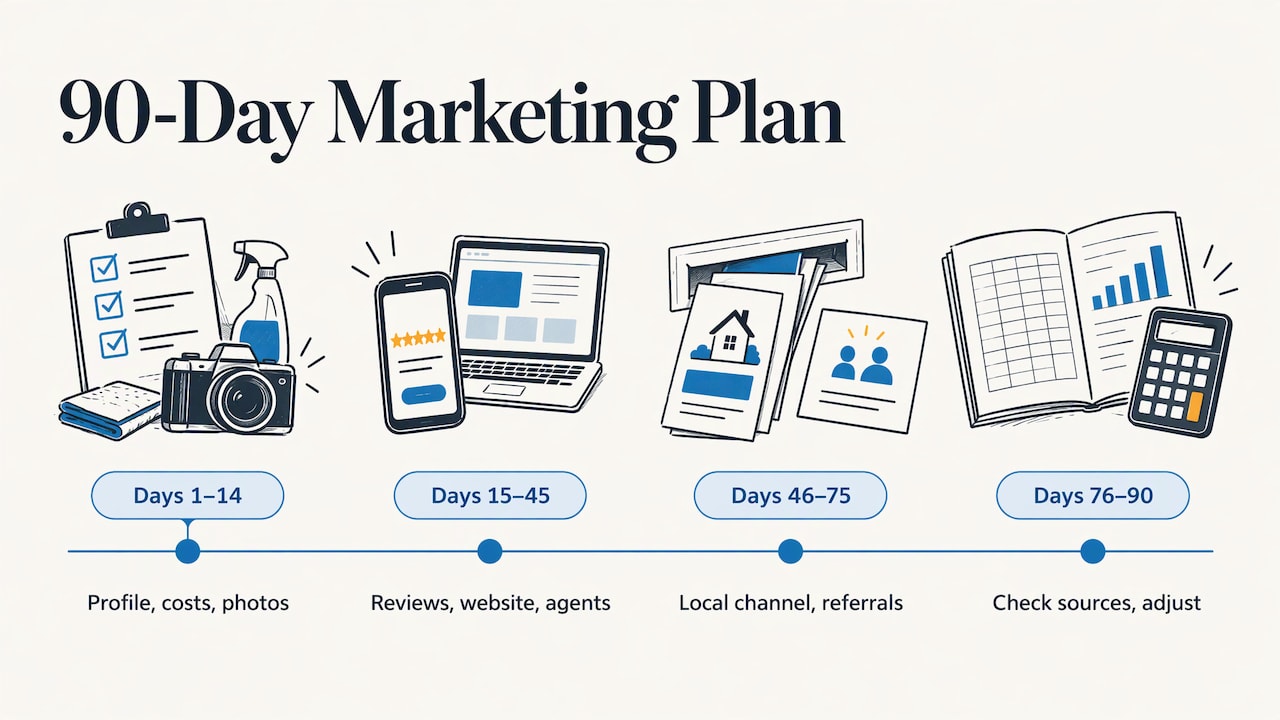
Repeat the cycle each quarter. Growth in a service business comes from a steady loop of delivering well, collecting proof and putting that proof in front of the right people.
Avoid the mistakes that stall growth
- Competing only on price. The lowest quote wins the clients who leave first. Win on reliability and reviews instead.
- Growing faster than you can staff. Hire when your diary has been full for several weeks, and train new cleaners on your checklist before they work alone.
- Ignoring missed calls. A cleaner on a job cannot always answer. Use a voicemail message that promises a callback time, and honour it.
- No written scope. State what each clean includes. Clear scopes cut disputes and justify your price.
- Inconsistent details online. Keep your name, phone and service areas identical on every page.
FAQ
How do I get more cleaning clients quickly?
Start with what already exists: ask past clients for reviews and referrals, complete your Google profile and introduce yourself to local property managers. These bring work within weeks and cost little. Then add a curated listing and one local channel.
How much should I spend on marketing a cleaning business?
Set the limit from your numbers, not a fixed percentage. Work out what a regular client is worth in profit, then spend no more than a fraction of that to win one. Start small and increase only when a channel is clearly paying for itself.
Do I need a website to promote a cleaning business?
A simple site is worth having because customers check it before they book. A few pages with your services, areas, insurance status and a quote form are enough. A strong listing and Google profile support it.
How can I grow a service business beyond cleaning?
The same pattern applies to plumbers, pest controllers and chiropractors: be specific about who you serve, collect real reviews and be easy to find locally. Business In Focus lists many service sectors, so the directory of local businesses shows how others in your field present themselves.