The most dependable way to find a handyman is to start from a shortlist of verified local businesses, then check each one against public records and compare three written quotes on the same job. Word of mouth helps, but it is only the first filter. Licence registers, insurance certificates and a written scope of work tell you what a recommendation can’t. Business In Focus is a curated directory of verified Australian local businesses, with independent reviews and consumer advice, so your shortlist starts with providers that have already been selected on credentials, reputation and service performance.
This guide covers where to look, what to check, what to ask, how to read a quote and what to do when a job goes wrong.
TL;DR
- Build a shortlist of three from verified listings and people you trust, then get three written quotes on an identical job description.
- Check the ABN, the business name and, where the work needs it, the licence on your state regulator’s register.
- Ask for a certificate of currency for public liability insurance, plus references and photos of recent work.
- Get the scope, total price, call-out fee and timing in writing, even for a small job. Put any changes in writing too.
- Delays, poor communication and unfinished work are early warning signs. Raise them in writing straight away.
Table of Contents
- What “dependable” actually means for a handyman
- Step 1: Work out the job before you search
- Step 2: Build a shortlist from sources that have been screened
- Step 3: Check who you are really hiring
- Step 4: Ask the right questions
- Step 5: Get three written quotes and compare them
- Step 6: Agree it in writing before work starts
- Warning signs to take seriously
- Why a verified directory shortens the process
- Are you a handyman or local tradie? Get listed
- A simple checklist before you book
- FAQ
What “dependable” actually means for a handyman
A dependable handyman does four things: turns up when they said they would, does the work they quoted for, charges the price you agreed, and fixes problems without a fight. Skill matters, but those four behaviours are what you are really hiring.
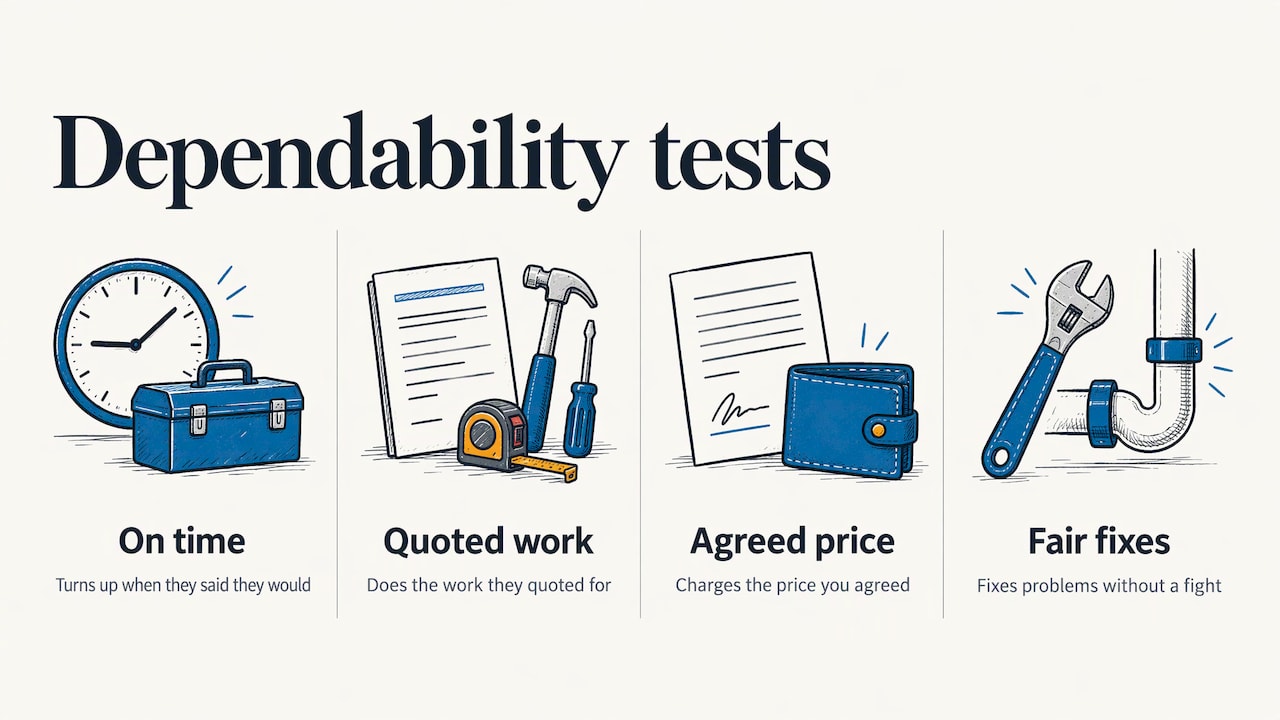
Consumer Affairs Victoria turns this into reference questions you can ask a past client. Did the tradesperson start and finish on time? Did they communicate clearly about changes? Did the price go up, and was that agreed? Was the client happy with the quality? You can find those questions in its checklist for home improvements costing $10,000 or less. Keep them in mind as the test for every handyman on your list.
The word “handyman” is also loose in Australia. It can mean a one-person operator doing flat-pack assembly and fence repairs. It can also mean a business sending someone to patch plaster, hang doors and fix gutters. The checks below work for both. The legal limits on what a handyman may do, covered later, are the same for both.
Step 1: Work out the job before you search
A vague request produces vague quotes, and vague quotes are where disputes begin. WA Consumer Protection advises being clear about what you want done and when you need it finished before you contact anyone.
Write a short brief:
- What: “Replace the cracked bathroom tile in the shower recess, regrout the wall, reseal the edges” beats “fix bathroom”.
- Where: the address, access, parking, and whether anyone is home.
- When: your ideal window and your hard deadline, such as an inspection or a visit from family.
- Materials: who buys them, and whether you already own some.
Then sort the job by trade. A handyman can do carpentry repairs, mounting, assembly, painting touch-ups and general maintenance. Work involving water supply, drainage, gas or the electrical system generally belongs to a licensed plumber, gasfitter or electrician. If your list includes a leaking tap, a blocked drain or a dead power point, go straight to the licensed trade. Our verified plumbers and electricians pages are the quickest place to start.
Step 2: Build a shortlist from sources that have been screened
You want three candidates. Where they come from decides how much checking you have to do afterwards.
Verified local listings
The Business In Focus directory features only businesses selected on verified credentials, reputation and service performance. Listings can’t be bought through promotions. Each business profile is professionally written and reviewed, so you get substance to read, not just a name and phone number. Browse by service and suburb, read the independent reviews, and shortlist the businesses that match your job. Our consumer advice section adds guidance on what typical jobs involve and what they should cost.
Recommendations from people you know
WA Consumer Protection lists recommendations first among the ways to find tradespeople, alongside reviews and references to recent work, in its hiring guidance. Ask neighbours, your body corporate manager, the local community group or a colleague. Ask a useful question: “What was the job, and would you have them back?” A recommendation for a tiling job doesn’t prove someone is good at fences.
Reading reviews properly
A run of five-star reviews written in the same week tells you little. Look for reviews that name the job, mention timing and say how problems were handled. Read the middling ones: how a business reacts to a three-star review shows you how it will treat you when something goes wrong.
Where search results can mislead
A search for “handyman near me” returns big franchises, lead-generation pages and one-person operators in the same list, and nothing in the list tells you which is which. That is why the checks in the next step matter more than the order in which results appear.
Step 3: Check who you are really hiring
These checks take about ten minutes per candidate and are free. Do them before you ask for a quote, not after you’ve grown fond of the person who turned up.
Identity and ABN
Access Canberra tells consumers to search the tradie’s ABN on the Australian Business Register and to know their full name, registered business name and ABN before signing anything. Its guide to choosing a tradesperson covers it. If a handyman is vague about their business name or won’t give an ABN, move on.
Licence or registration
Whether a licence is required depends on the work and the state. Each state runs its own register, and the rules differ:
- NSW: a licence is required for residential building work valued at more than $5,000 including GST in labour and materials, and for all specialist work regardless of cost. The licence check shows the holder’s name, licence numbers, categories and expiry dates, as explained on the NSW Government licence-check page. You can use the Verify NSW website to do it, per the NSW step-by-step guide.
- Victoria: the Victorian Building Authority says most work worth $10,000 or more requires the practitioner to be registered or licensed with the Building and Plumbing Commission. You should also check whether the work needs a licensed or registered practitioner even when it falls below that figure. See its guidance on finding a practitioner.
- Queensland: QBCC licence searches can confirm whether a tradesperson is licensed and whether any directions have been made against them in the past, as the ABC’s consumer protection explainer notes.
The disciplinary history is worth reading as well. The Victorian Building Authority advises checking the disciplinary register, and the NSW licence check shows cancellations, suspensions and prosecutions under the relevant Acts. That is hard information, which word of mouth can’t give you.
For other states, search “[your state] licence check” and use the regulator’s own site.
Insurance
Ask to see a certificate of currency for public liability insurance. Consumer Affairs Victoria says it protects you or third parties against damage the workers may cause, in the same checklist. A certificate shows the policy period and cover amount, so check that the date is current.
For larger projects in NSW, the government says you should also check Home Building Compensation Fund insurance for projects over $20,000. That cover must be in place before any work starts or any payment, including a deposit, is accepted. That is rarely relevant for a handyman job, but it applies if your repairs grow into a renovation.
Step 4: Ask the right questions
A short phone call separates the professionals from the rest. NSW Government guidance suggests asking whether you can see reviews or references from previous clients, whether past projects finished on time and within budget, and who will supervise the work. It also advises asking for examples of past work, in its step-by-step guide.
A practical list for a handyman:
- Have you done this exact job before? Can I see photos?
- Can you give me the contact of a recent client?
- Will you do the work yourself, or send someone else?
- Are you licensed or registered for any part of this work that requires it?
- Can you send me your public liability certificate of currency?
- When can you start, and how long will it take?
- How do you charge: by the hour, by the job, or by the half day? Is there a call-out fee?
- What happens if the job takes longer than you expected?
Listen to how they answer as much as what they say. A dependable handyman will usually be glad to explain their process. Vagueness, pressure to decide on the spot or a cash-only demand are all reasons to keep looking.
Step 5: Get three written quotes and compare them
Three quotes is the line every government source draws. WA Consumer Protection advises at least three quotes in writing before you agree to the work. Consumer Affairs Victoria says three quotes on the same detailed description of the job. The ABC explainer, quoting Master Builders Queensland’s CEO, says the same: collect a minimum of three.
Give each candidate the same brief from Step 1. That is the only way the quotes can be compared.
What a good quote contains
WA Consumer Protection says a written quote should include the job description, the materials price, labour charges, the time needed to finish, call-out fees and any weekend or public holiday rates if you need them. The Victorian Building Authority adds that you should ask for an itemised quote and compare:
- inclusions and exclusions
- labour and call-out fees
- compliance certificates, where relevant
- whether permits are needed
- whether the price is fixed or variable
How to read the three side by side
| Check | What to look for |
|---|---|
| Scope | Same tasks listed in all three? A low quote often leaves something out. |
| Price type | Fixed price or estimate? An hourly rate with no time estimate is open-ended. |
| Call-out fee | Is it charged separately, or included in the total? |
| Materials | Who supplies them, and is there a markup? |
| Timing | Start date and finish date, not just “next week”. |
| Extras | Rubbish removal, clean-up, after-hours rates. |
| Paperwork | ABN, licence number where relevant, insurance details. |
The cheapest quote isn’t automatically the best, and neither is the most expensive. If one quote is far below the others, ask what it leaves out. If one is far above, ask what it includes that the others don’t.
What will it cost?
Handyman pricing in Australia varies by city, by the job and by whether the handyman charges hourly or per job. There is no single national rate worth relying on, which is why the written quotes matter. Most handymen add a call-out fee or a minimum charge for short visits, and some charge more on weekends and public holidays. Ask about each before you agree to anything. For work that belongs to a licensed trade, our guide to what a plumber costs in Australia shows how pricing is explained for that trade.
Step 6: Agree it in writing before work starts
Consumer Affairs Victoria says to have a written contract for all work, even small jobs. It should clearly specify the work to be done and the total cost, and any agreed changes should also be put in writing.
For a small handyman job, the written agreement can be the accepted quote plus a confirming email. Before the first tool comes out, make sure it covers:
- the scope of work and the total price
- the start date and expected finish date
- payment timing (avoid paying everything up front; agree on a deposit, if any, and a final payment on completion)
- who supplies and removes materials
- how variations will be handled and approved
After the job, walk through the work with the handyman before you pay the final amount. Check it against the written scope, and take photos.
Warning signs to take seriously
icare NSW lists delays, poor communication and unfinished work as warning signs that a project is going off track. Noticing them early can stop bigger problems later. In practice, watch for:
- the handyman stops answering calls or messages
- repeated rescheduling with thin excuses
- requests for more money before the agreed milestone
- work left half-finished while they start another job
- reluctance to put changes or extra costs in writing
- no ABN, no business name, or a licence number that doesn’t match the register
If something goes wrong, icare advises raising your concerns with the tradesperson and following up in writing. If you can’t resolve it directly, contact the regulator or dispute resolution body in your state. For NSW, icare points to Building Commission NSW, as set out in its guidance on what to do when something goes wrong. Keep your quote, messages, photos and payment records together, because they are the evidence a regulator will ask for.
Why a verified directory shortens the process
Most of the checking above exists because it is hard to tell a good provider from a poor one from the outside. A directory that screens before it lists does part of that sorting for you. Business In Focus selects every listing on verified credentials, reputation and service performance, and doesn’t let businesses buy their way in with promotions. The directory earns its income from annual listing fees for professionally written business feature pages, not from ads or affiliate links. You can read the independent reviews and the written profile before you call anyone.
That gives you a shortlist worth quoting from. You still do the verification steps, because they protect you on every job, but you start with providers that have already cleared a selection standard. For trades such as plumbing and electrical work, where a licence is part of the job, you can go straight to the plumbers directory or the electrician directory.
Are you a handyman or local tradie? Get listed
If you run a handyman or trade business and want to be found by homeowners who check before they hire, a listing on Business In Focus puts a professionally written feature page in front of them. Plans are billed annually: Basic is $99 per year, Pro is $199 per year and Agency is $449 per year. You can see the plans and add your business on the listing plans page.

Listings are selected on credentials, reputation and service performance, so the page you publish is read by customers who are looking for exactly that.
A simple checklist before you book
Print it, or keep it on your phone:
- Brief written, with scope, location and deadline.
- Three candidates shortlisted from verified listings and trusted recommendations.
- ABN, business name and, where needed, licence checked on the official register.
- Certificate of currency for public liability insurance seen.
- References or photos of similar recent work reviewed.
- Three written, itemised quotes on the same brief compared.
- Scope, price, timing and variations confirmed in writing.
- Final payment made only after you’ve inspected the finished work.
Follow it every time, even for small jobs, and the reliable tradies stand out quickly. They answer your questions, send clear quotes and turn up when they said they would.
FAQ
What is the best way to find a reliable handyman?
Start with a shortlist of three from verified local listings and people you trust. Check each candidate’s ABN and any licence on the official register, then ask for references and a certificate of currency for public liability insurance. Finally, get three written quotes on the same job description before you choose.
Does a handyman need a licence in Australia?
It depends on the state and the work. In NSW, a licence is required for residential building work over $5,000 including GST and for all specialist work regardless of cost. In Victoria, most work worth $10,000 or more requires registration or licensing. Plumbing, gas and electrical work generally need a licensed trade, so check your state regulator’s register.
How many quotes should I get for a small job?
At least three. WA Consumer Protection, Consumer Affairs Victoria and the NSW Government all recommend this, and the quotes should be in writing and based on the same job description. Compare the scope, call-out fee, materials and timing, not just the bottom line.
What should a handyman’s written quote include?
WA Consumer Protection says a quote should include the job description, materials price, labour charges, the time needed to finish, call-out fees and any weekend or public holiday rates. Fixed or variable pricing and any permits or certificates needed should also be stated clearly.
What should I do if a handyman does poor or unfinished work?
Raise the problem with them promptly and follow up in writing, keeping your quote, messages and photos. If it can’t be resolved directly, contact your state’s consumer or building regulator for dispute resolution. In NSW that is Building Commission NSW.