A business spotlight article is a short story about one local business: who runs it, how it started, what it does for customers and what it gives back to its area. The best ones read like journalism, not advertising. If you are a business owner, the quickest route to a credible one is a feature written to editorial standards and placed on a page built to be found. That is what we do at Business In Focus, where every listing is selected on verified credentials, reputation and service performance, and quality cannot be bought through promotions.
This guide covers what a spotlight is, what separates a trustworthy one from a disguised ad, how to write or pitch one, and where a feature fits in your wider visibility.
TL;DR
- A business spotlight (also called a local business feature or profile) tells the story of one business: its origins, its people, its work and its community role.
- Councils run free spotlights with eligibility rules. Publications and directories run others, and paid ones should say so clearly.
- A credible feature names the business, gives checkable facts and leads with the story, not the sales pitch.
- Readers can test any spotlight by asking who wrote it, who benefits and whether the claims can be verified.
- Business In Focus writes professional feature pages for local businesses, from $99 per year, on a directory that only features verified businesses.
Table of Contents
- What a business spotlight article actually is
- Why a spotlight helps the business and the community
- How to tell a credible spotlight from a disguised ad
- What a good business feature includes
- Writing and pitching a local business feature
- Where a professionally written feature fits
- Getting featured with Business In Focus
- A checklist before you publish or commission a feature
- FAQ
- Sources
What a business spotlight article actually is
A spotlight is a profile, not a product page. It answers the questions a neighbour would ask: what does this business do, how did it begin, where is it heading and who does it help?
Australian councils use the format often. The City of Greater Bendigo’s Spotlight on a Local Business program asks about what the business does, how it started, its future plans and its support for the community. Willoughby City Council’s Support Local campaign uses storytelling, video features and interviews to spotlight local businesses, encourage residents to shop locally and sustain jobs.
The same idea turns up under several names: local business spotlight, business feature article, local company feature. They all mean a story-led profile of a single business, as opposed to a news report on an industry or a list of businesses.
How it differs from other business coverage
| Format | Main purpose | Who it is about |
|---|---|---|
| Spotlight or feature | Tell one business’s story | One business and its people |
| News report | Report something that happened | An event, trend or announcement |
| Directory listing | Help people find and contact a business | Many businesses, short entries |
| Advertisement | Sell a product or service | The offer, in the advertiser’s words |
A directory listing gives a name, a phone number and a category. A spotlight gives a reason to trust the business behind them.
Why a spotlight helps the business and the community
For the owner, the value is credibility. A reader who has seen the story behind a business, its history, its people and its standards, arrives at the phone call or the enquiry form already warmer than someone who found only a name and a number.
For the community, the value is local knowledge. Willoughby’s council says its campaign aims to help shield the community from wider economic challenges while giving businesses exposure. In Western Australia, the Peel Development Commission’s Local Business Spotlight on SPB Energy Solutions shows how a feature can share practical lessons too. The business advised treating a capability statement as a strategic tool that accurately reflects real capabilities, values and experience, which adds credibility when pursuing larger commercial work.
That last point is the pattern worth copying. The best spotlights teach the reader something, so the business gets remembered for what it knows, not only for what it sells.
How to tell a credible spotlight from a disguised ad
Homeowners are the readers who most need this. When you are choosing a plumber, electrician or cleaner, a glowing profile can help or mislead, depending on how it was produced.
Four questions to ask of any feature
- Who wrote it, and who is behind the page? The Australian Education Research Organisation’s guide to evaluating non-academic sources builds on a simple test of purpose, authority and whether evidence can be verified.
- Who benefits if you believe it? The Australian Associated Press advises checking a source’s affiliations and whether it benefits financially from the claim, and being sceptical of statistics with no stated origin.
- Can you check the facts? A credible feature names the business, gives a web address and contact details, and states things you can confirm: licences, years in operation, locations served.
- Is any payment disclosed? ABC’s Media Watch has documented paid stories that were not clearly labelled for readers arriving from search engines or social media, and noted that most editors agree readers should be told when a story has been paid for.
The Tech Business News rule of thumb is blunt: if a report exists mainly to promote a company, it is promotion, not news. That does not make promotion bad. It makes honesty about it essential.
Watch for fake or recycled praise
Reviews alongside a feature matter too. The ACCC lists signs that a review may be fake, including reviews written in similar language to others for the same business. Reviews should be independent and reflect a genuine experience. If a page has ten reviews that all sound the same, treat them with caution.
A directory that features only verified businesses and ranks on reputation rather than payment for placement removes much of this guesswork. You can browse that kind of curated selection on our service listings page.
What a good business feature includes
Whether a council writes it, a journalist writes it or the business commissions it, the strong ones share the same bones.
- A headline that promises a reason to read. Not “Smith Plumbing: Quality You Can Trust”, but something that points to the story: a third-generation family trade, a local hire, a problem solved.
- The most important information first. Small Business Connections warns that journalists cut stories from the bottom to fit print space, so the key point cannot wait for paragraph six.
- The business named clearly, with contact details. Readers who like the story need an easy next step.
- People, not slogans. The owner’s reason for starting, a staff member’s view, a customer outcome.
- Checkable proof. Licences, qualifications, years trading, areas served, real project examples.
- Community connection. Greater Bendigo’s questions cover support for the community, and the NSW Small Business Commissioner’s fact sheet lists a positive community effect among the angles local media find newsworthy.
- A clear next step. A phone number, a web address or a booking link.
A short worked example
Take a fictional Brisbane electrician, Dana, who left a large contractor to start her own company and now employs two apprentices from the local TAFE.
A weak feature opens: “Dana’s Electrical offers fast, reliable service at competitive prices.” Nobody remembers that.
A strong one opens with Dana on a site visit, explaining why she trains apprentices in her own ute. The second paragraph names the business, the suburbs it services and her licence details. The third gives the benefit: faster callbacks because the team is small and local. The story carries the sales message without ever shouting it.
Writing and pitching a local business feature
There are two routes: get someone else to write about you, or commission a professionally written feature. Many businesses do both.
Earning coverage from councils and local media
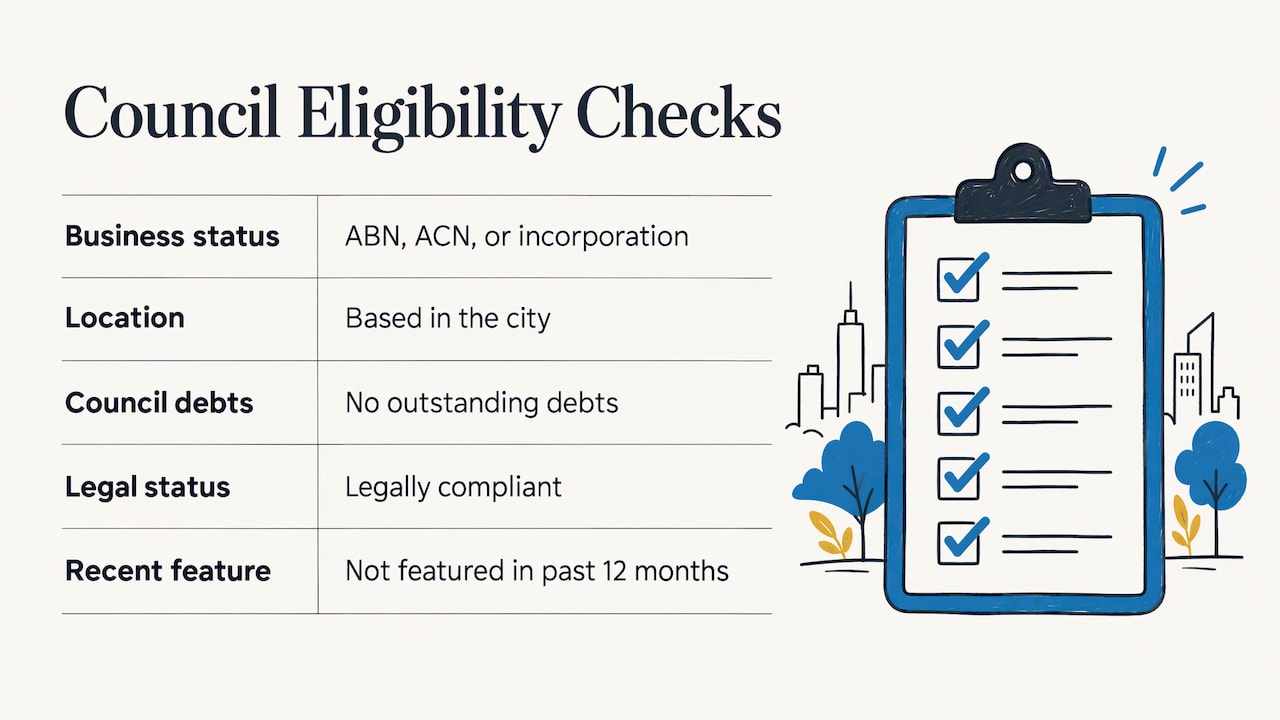
Council programs are the most accessible entry point, and the rules are worth reading. Greater Bendigo says being featured is free, but completing the form is not a guarantee. Eligible businesses must have an ABN or ACN or be incorporated, be based in the city, have no outstanding debts to Council, be legally compliant, and not have been featured in the previous 12 months. Check your own council’s economic development page for a similar program.
For local newspapers and trade sites, the pitch is everything. Inside Small Business says the biggest mistake is pitching the media as you would potential clients. Journalists want the story behind the business, and the publication calls this earned media, as opposed to paid media such as advertising.
Its model pitch is instructive: start with the person, not the product, tie it to a wider narrative, and make it about value to the reader. Its example is a founder made redundant during Covid who went on to win an industry award and employ six locals.
What makes a story newsworthy locally
The NSW Small Business Commissioner’s fact sheet on working with the media lists the angles that tend to interest local outlets:
- something new that generates excitement
- a positive effect on the community, such as an event, charity work or support
- money saved for the community
- a link to a community need or local event
- a “big deal” angle
It also advises preparing a brief overview, the community benefits, a call to action and your key interview messages before you approach anyone.
Common mistakes
- Pitching price, specials or stockists. Journalists treat these as advertising.
- Leading with the product instead of the person.
- Sending a long attachment with no angle in the email itself.
- Burying the key fact at the bottom of the piece.
- Claims with no evidence behind them.
Where a professionally written feature fits
Earned coverage is free but uncertain, slow and out of your hands. Councils feature a business once in a while, and editors choose their own angles. A professionally written feature gives you a story you can point customers to the day it goes live.
That is the idea behind the feature pages on Business In Focus. Our profiles are professionally written, reviewed and placed on targeted landing pages, which makes them more substantial than a standard directory entry. Because we select listings on verified credentials, reputation and service performance, a feature sits alongside other verified businesses, not alongside whoever paid for the loudest placement. Our income comes from annual listing fees, not from advertising or affiliate links.
The same story also supports your wider presence. Our guides on using online business listings well and on local citations for SEO show how consistent details across the web back up a feature. If you are curious how pricing works across the sector, see our directory listing pricing guide.
Getting featured with Business In Focus
Business listing plans are priced per year:
| Plan | Price |
|---|---|
| Basic | $99 per year |
| Pro | $199 per year |
| Agency | $449 per year |
The Agency plan is built for agencies; sole traders and local businesses can choose the plan that suits them. You can compare the options and apply on our Add your business page.
If you are a homeowner, you do not pay anything. You can read the independent reviews and browse verified providers for plumbers, electricians and house cleaners, or read a sample of how a business is presented in our Silverwater Plumbing review.
A checklist before you publish or commission a feature
- Does the headline offer a reason to read, not a slogan?
- Does the first paragraph carry the strongest point?
- Is the business named, with a web address and a contact?
- Is every claim something a reader could confirm?
- Is there a person in the story, not just a product?
- Is the community benefit specific?
- Does it end with one clear next step?
- If anything was paid for, is that clear to the reader?
If you can answer yes to all eight, the piece is ready to carry your name.
FAQ
What is a local business spotlight?
It is a short profile of one local business, covering its story, its people, its work and its place in the community. Councils, local media and directories all publish them. Some are free and selected on suitability, while others are written for a fee.
Is it free to be featured in a business spotlight?
Council programs often are. Greater Bendigo’s is free, though selection is not guaranteed and eligibility rules apply. A professionally written feature on a directory such as ours is paid for by the business through an annual listing, starting at $99 per year on the Basic plan.
How long should a business feature article be?
Long enough to tell the story and prove the claims, short enough to be read in a few minutes. Lead with the strongest information, because editors cut from the bottom and readers drop off early. Aim for a clear headline, a strong opening paragraph and a few short sections of evidence.
How do I know a spotlight is not just an ad?
Check who published it, who benefits and whether the facts can be verified. Look for disclosure when a story has been paid for, named contact details and claims you can confirm, such as licences and years in business.
What should I put in a pitch to a journalist?
Start with the person and the angle, not the product. Explain the value to the publication’s readers, keep the pitch short and offer options for how the story could be told.
Sources
- Spotlight on a Local Business, City of Greater Bendigo
- Support Local, Willoughby City Council
- Local Business Spotlight: SPB Energy Solutions, Peel Development Commission
- Evaluating non-academic sources, Australian Education Research Organisation
- How do you know what information sources to trust? AAP
- Spot the sponsored content, ABC Media Watch
- When a report isn’t news, Tech Business News
- Online reviews for product and services, ACCC
- Working with the media, NSW Small Business Commissioner fact sheet
- The media loves a good story, Inside Small Business
- PR for small-business owners: what a good pitch really looks like, Inside Small Business
- 7 steps to local media coverage, Small Business Connections