Directory listing prices in Australia run from $0 for a basic profile to several hundred dollars a month for managed advertising, and the price on its own tells you very little. What matters is what the fee buys, how long you are locked in and whether the directory only takes money or also checks who it lists. At Business In Focus, listings are annual and flat: Basic is $99 per year, Pro is $199 per year and Agency is $449 per year, and quality is the entry test rather than a bigger budget.
This guide is for small business owners weighing up a fee, and for homeowners curious about why some local businesses seem to appear everywhere. It sets out the pricing models you will meet, the factors that move a quote, a simple way to work out whether a listing pays for itself and the terms to read before you sign.
TL;DR
- Basic business profiles are often free; paid fees buy extra visibility, written content or managed services, not a basic presence.
- Three pricing models dominate: free profiles, flat annual listing fees and monthly or per-click advertising with minimum terms.
- Compare directories on total cost over the whole contract, including setup fees, GST, renewal price and exit fees, not the headline monthly figure.
- Divide what you paid by the enquiries and jobs the listing produced, then decide at renewal.
- Business In Focus charges $99, $199 or $449 per year for professionally written listings, and does not sell higher ranking through promotions.
Table of Contents
- What a directory listing costs in Australia
- What paid listing fees cover
- Why quotes for the same product differ so much
- A simple way to calculate return
- Contract terms to check before you pay
- How other directories show their prices
- Business In Focus plans and prices
- What this means for homeowners
- A short checklist for choosing a directory
- FAQ
- Sources
What a directory listing costs in Australia
There is no single market price, because “directory listing” covers products that have little in common. In practice Australian businesses meet four price points.
| Model | Typical price shape | What you usually get |
|---|---|---|
| Free profile | $0 | Name, address, phone, opening hours, a link to your website |
| Flat annual listing | A fixed yearly fee, in our case $99 to $449 per year | A written feature page or enhanced profile, category placement, reviews and credibility signals |
| Monthly advertising plan | A monthly fee, often with a 6 or 12 month minimum | Prominent placement, extra photos, call tracking, sometimes a basic website |
| Managed digital bundle | Monthly fee plus a one-off setup fee | Website, SEO and social media managed by the directory’s team |
The figures shift by provider and over time, so treat any price you read, including in this article, as a snapshot and ask for the current one in writing. The useful point is the shape. A free profile has no downside beyond the time to keep it accurate. A flat annual fee is easy to budget and compare. A monthly plan with a minimum term is the one where small print decides whether the deal is good.
Are basic listings free?
Yes, in most cases. Major search, map and review platforms let you claim a basic business profile at no charge, and plenty of Australian directories do the same. Paying is optional and tied to extras. If someone quotes you a fee for simply appearing with your name, address and phone number, ask what that fee covers that a free profile does not.
Claim the free profiles first and make sure your business name, address and phone number are identical on every one. Consistency across listings is the point of what the industry calls a local citation, a mention of your business details on another website. Our guide to local citations for SEO in Australia explains how to keep those details tidy, and how to use online business listings well covers what to do once the profiles exist.
What paid listing fees cover
When you pay, the money normally goes toward one or more of these.
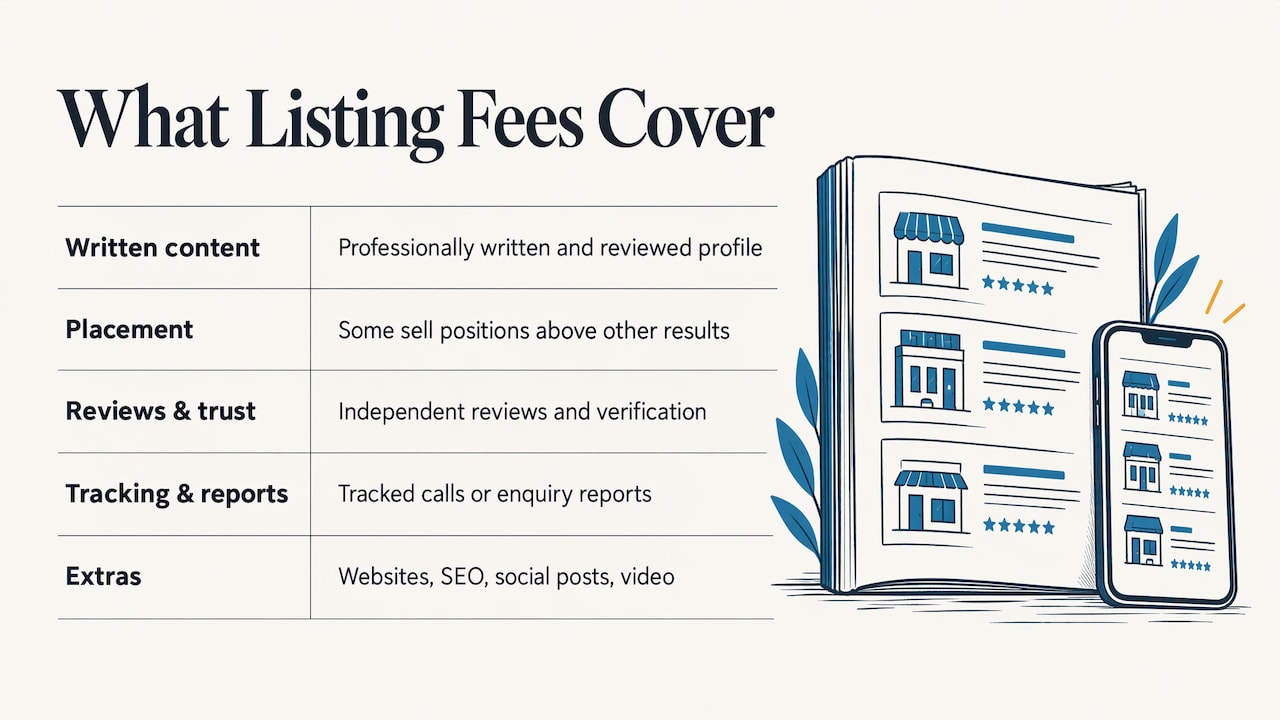
Written content. A professionally written business page gives customers more than a phone number: who you are, what you do, where you work and why people trust you. This is the main thing a flat annual fee at Business In Focus buys: our profiles are professionally written and reviewed, then placed on targeted landing pages, so they carry more substance than a standard directory entry.
Placement. Some directories sell positions above other results. Others, including ours, do not let money change who is listed or how they are judged. If a directory promises you a higher spot for a higher fee, test whether that spot is shown to real searchers and whether it changes the number of enquiries.
Reviews and trust signals. Independent reviews and verification mean a customer can see that a business has been checked. Homeowners searching for a plumber, electrician or cleaner care about this far more than about a logo.
Tracking and reporting. Some paid plans include a tracked phone number or enquiry reports. These are useful only if the report is complete. Ask what is counted, what is not and whether you can see the caller’s number.
Extras. Websites, SEO work, social posts and video are often sold as add-ons, and they account for most of the gap between a cheap listing and an expensive one.
Why quotes for the same product differ so much
Three factors explain most of the spread.
- The directory’s reach. A directory that real customers search in your category and suburb is worth more than a bigger one they never open. A trade directory with a few hundred visits a month is not comparable with a national platform on price per listing.
- The tier. Entry tiers are priced to get you listed, and top tiers add content, placement and support. Compare tiers by what is written down in the plan, not by name.
- Add-ons and bundling. A listing sold alongside a website or an SEO package can look cheap per month while the setup fee does the real work. A site package with a one-off setup fee in the thousands, spread across a 12-month term, is a very different purchase from a $99 annual profile.
Location and category matter too. A sole-trade electrician in Brisbane and a multi-site cleaning agency do not need the same thing, which is why we price a single-business listing differently from an agency one.
A simple way to calculate return
Before you pay, set a break-even number. Take the total cost of the listing over its term, add the time you spend maintaining it, and divide by your average profit per job.
Worked example. A plumber considers a listing at $199 for the year. Their average job earns $350 in gross profit. $199 divided by $350 is 0.57, so one extra job a year covers the listing. If tracking shows three enquiries and one won job in twelve months, the listing paid for itself. Compare that with a plan at $300 a month: the annual cost is $3,600 before GST, so the same plumber needs about ten extra jobs a year just to break even, and the minimum term means the money is committed before any result is known.
To make the figures meaningful:
- Record a baseline. Count your enquiries for three months before you buy, and note how each customer found you by asking them.
- Use a unique phone number or enquiry form for each listing so you can see where calls come from.
- Count the whole term. A listing that is quiet in month two may have produced work by month six.
- Review before renewal. Put the renewal date in your calendar at least a month ahead, so you decide on the figures rather than on an invoice.
A free listing that produces nothing still costs time to maintain, and a modest paid one that produces a job can be good value. Judge each by cost per won job, not by whether it is free.
Contract terms to check before you pay
The monthly price is the part salespeople show you. The terms that cost you money are elsewhere. Get these answered in writing:
- Price including GST. Many small business quotes are given ex-GST, and the difference on a large plan adds up quickly.
- Minimum period. Six and twelve months are common for monthly digital products, and you pay for the whole period whether or not it works.
- Renewal price and method. Find out whether the plan renews automatically and at what price, and how much notice you must give to cancel.
- Cancellation or exit fee. Some contracts charge the remaining balance of the term if you leave early.
- Setup fees. One-off charges can dwarf the monthly fee in the first year.
- Reporting. What is measured, how often and whether you can see full call details.
Small businesses have some protection against one-sided terms. The unfair contract terms rules in the Australian Consumer Law apply to standard-form contracts where a party has fewer than 100 employees or turnover under $10 million, thresholds that applied from 9 November 2023. Auto-renewals with no reminder, unilateral price changes and exit fees unrelated to real cost are the usual examples flagged. If you are unsure whether a contract is fair, a lawyer or your state small business commissioner is the right person to ask before you sign.
Beware of “free listing” invoices
Some directory offers are nothing more than a bill dressed up as a favour. The ACCC has warned businesses about unsolicited emails and letters offering “free” directory listings that turn out to carry a binding fee in the fine print, with the business then told it owes the money. If a form arrives that you did not request, do not sign or return it until you have read every line, and check whether you are agreeing to a paid term. Report suspicious offers to the ACCC’s Scamwatch.
How other directories show their prices
Pricing pages differ between countries, but the structure is similar everywhere: tiers, upgrades, priority placement and sometimes an audit or website extra. A breakdown of what directory listings cost and include from a Kansas City directory shows how the same tier logic plays out in a US metro, with verified status, lead forms and priority placement as the usual paid upgrades. Use it as a pattern for reading any pricing page, then check each Australian provider’s own page for its current Australian-dollar prices and terms.
Business In Focus plans and prices
Our directory is built for the buyer who wants a real business rather than a paid-for position. Every listing is selected on verified credentials, reputation and service performance, and quality cannot be bought through promotions. Listings are funded by annual fees from the businesses we feature, not by advertising or affiliate links.
| Plan | Price |
|---|---|
| Basic | $99 per year |
| Pro | $199 per year |
| Agency | $449 per year |
Each plan is an annual fee for a professionally written business feature that is reviewed and placed on targeted landing pages. Agencies and sole traders choose the plan that matches how many businesses they manage.
If you are a local business ready to be seen by homeowners comparing providers, you can see the plans and add your business on our Basic, Pro and Agency listing page.
What this means for homeowners
If you are a homeowner reading about directory pricing, the takeaway is simple: a business that pays to be seen is not automatically a good business. What counts is how a directory chooses who to include. When you search for a trade, look for a directory that explains its selection, shows independent reviews and does not sell the top spot. You can browse verified providers in our directory of trusted local businesses, or go straight to a category such as electricians or chiropractors.
A short checklist for choosing a directory
- Claim the free profiles first and keep the details consistent.
- Ask who the directory’s visitors are and which searches bring them.
- Compare the total cost across the whole term, including GST and setup fees.
- Prefer a flat annual fee you can budget for over an open-ended monthly plan.
- Get the renewal price, notice period and exit fee in writing.
- Track enquiries from the listing and decide at renewal on cost per won job.
For tradies and cleaners looking at wider marketing, our guide on how to promote a cleaning business in Australia shows where a listing fits among the other options.
FAQ
How much does a business directory listing cost in Australia?
Basic profiles are often free. Paid options range from flat annual fees to monthly plans with minimum terms and setup charges. At Business In Focus, plans are $99, $199 and $449 per year. Always ask for the price including GST and the total over the full term.
Are directory listing fees worth paying?
They are when the extra visibility or content produces enquiries that win jobs worth more than the fee. Work out your break-even: total cost divided by profit per job. Track enquiries for the whole term and decide at renewal with your own numbers.
What should I ask before signing up?
Ask for the price including GST, the minimum period, the renewal price, the cancellation fee and what the reports measure. Get the answers in writing. If you did not ask for the offer, read it especially carefully, as the ACCC has warned about unsolicited “free listing” forms that carry fees.
Do paid listings rank higher?
It depends on the directory. Some sell higher placement inside their own results. At Business In Focus, quality cannot be bought through promotions: listings are selected on verified credentials, reputation and service performance.
Sources
- Unfair Contract Terms: The Law for Small Business
- ACCC warns about scam business directory offers
- Business Directory Pricing: What Listings Cost and Include