Local SEO for tradies comes down to four things: a complete Google Business Profile, a steady flow of detailed reviews, suburb-level pages that prove your work, and the same business details everywhere you are listed. Do those well and you appear when someone nearby searches for a plumber, sparky or cleaner. Add a verified listing on a curated directory such as ours, and you give customers one more trustworthy place to find you.
Local SEO simply means making it easy for Google, and for people, to see what you do, where you work and why locals trust you. It matters because a search like “blocked drain plumber near me” usually comes from someone with a problem right now.
TL;DR
- Fill in your Google Business Profile completely: the most specific main category, up to 20 service areas, real photos and hours.
- Ask every customer for a review at job completion, and ask them to mention the job and suburb.
- Give each major suburb you serve its own page with real jobs, photos and local detail.
- Keep your business name, address and phone number identical on every site and directory.
- Track phone calls and booked jobs, not just rankings, and give it several months.
Table of Contents
- What local SEO actually is, and why it suits tradies
- Step 1: Set up your Google Business Profile properly
- Step 2: Build reviews that help you rank and win the call
- Step 3: Make your website prove you work in each suburb
- Step 4: Keep your name, address and phone number consistent
- Customer acquisition beyond Google: where directories fit
- Where a Business In Focus listing fits
- How to tell whether it is working
- A simple 30-day plan
- FAQ
- Sources
What local SEO actually is, and why it suits tradies
Most trade work is local. A customer in Footscray does not want a plumber from Geelong. Search engines know this, so when someone types a trade plus a suburb, or “near me”, Google shows a map with a short list of nearby businesses, followed by regular website results.
Your aim is to appear in that map list and in those results for the services you want and the suburbs you actually cover. Four things drive it:
- Your Google Business Profile, the free listing that appears on Google Search and Maps.
- Reviews, which both influence ranking and persuade the customer reading them.
- Your website content, especially pages that match a service and a place.
- Citations, which are mentions of your business name, address and phone number (together called NAP) on other websites and directories.
If you want a wider overview of the tactics used in a neighbouring trade, this walkthrough of SEO strategies for electricians covers keyword and content ideas that carry across to most trades.
Step 1: Set up your Google Business Profile properly
This is the highest-value hour you can spend. Claim your profile, verify it, and then fill in every field.
Choose the right type of business. If you travel to customers and do not serve them at your premises, you are a service-area business. Google’s guidance says that if you do not serve customers at your address, you should remove your address from the profile. Plumbers and cleaners are the examples it gives.
Set your service areas carefully. According to Google, you can list up to 20 service areas, they should be as specific and accurate as possible, and the overall boundary should not stretch beyond about two hours’ driving time from where you are based. Name suburbs, not just the city. An inner-south Melbourne plumber is better off listing the suburbs they actually work in than writing “Melbourne”.
Pick the most specific categories. Google’s 2026 playbook says a profile can carry up to 10 categories, one primary and nine secondary. Choose “Plumber” over something vague like “Contractor”, then add secondary categories for services such as hot water or gas fitting only if you genuinely provide them.
Complete the rest.
- Business hours, including after-hours or emergency availability if you offer it
- A phone number you answer, or that reaches a message service
- A list of services with plain descriptions
- Photos of your team, vehicle and finished work, taken by you
A profile that is half filled looks abandoned to both Google and customers.
Step 2: Build reviews that help you rank and win the call
Reviews do two jobs. They help decide who appears first, and they help the customer decide who to call. A tradie with a handful of reviews from three years ago looks inactive, however good the work.
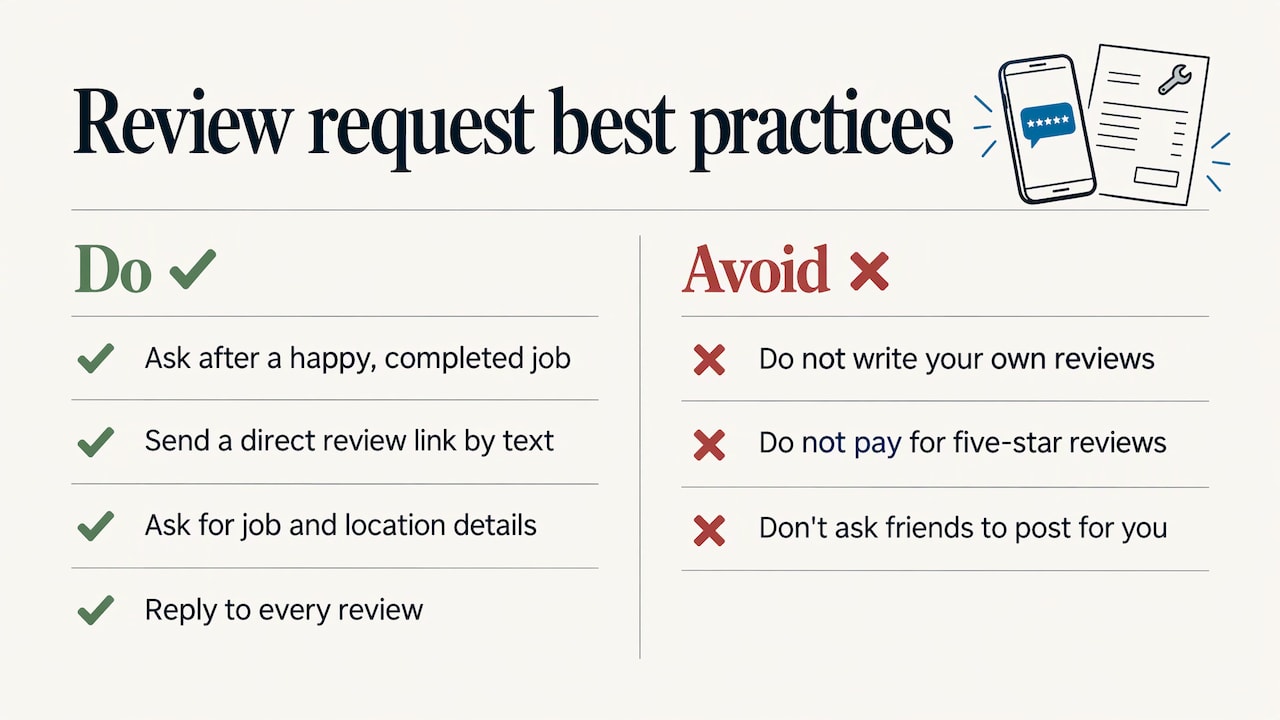
Ask at the right moment. The easiest time is when the job is finished and the customer is happy. Ask in person, then send a text with a direct link to your review page so it takes them under a minute.
Ask for detail. A review that says “great service” tells Google and readers little. One that says “replaced our hot water system in Parramatta, same day” tells them a great deal. You cannot script what customers say, but you can ask them to mention what you did and where.
Keep them coming. A steady trickle of recent reviews looks healthier than a burst followed by silence. Build the request into your finishing routine: invoice, thanks, review link.
Reply to every review. Thank people by name, mention the job, and keep it short. For the harder ones, our guide on how to respond to bad reviews walks through a calm approach that reads well to future customers.
Keep it honest. In Australia, it is against the law for a business to create fake or misleading reviews or to arrange for others to do so, according to the ACCC. Do not write your own, do not pay for five-star reviews and do not let a friend post on your behalf. Beyond the legal risk, a fake review can cost you the profile you spent months building.
Step 3: Make your website prove you work in each suburb
Google matches what a person searches to the pages that answer it. If a customer in Newtown searches “electrician Newtown”, a page about electrical work in Newtown has a better claim than a single page headed “Areas we service” with a list of 40 suburbs.
For each important suburb or area, build a page that includes:
- The services you offer there, in plain language
- Local context, such as the age of housing, common issues in the area or council requirements that affect the work
- A few real jobs, with your own photos
- Reviews from customers in that area
- A clear phone number and a booking or quote option
Start with your five best suburbs rather than all of them. Write each page for a customer, not for a search engine, and do not copy the same text with the suburb name swapped.
Use a job log as your proof
Keep a simple record of completed work: date, suburb, what the job was, before and after photos, and who did it. That log feeds your suburb pages, your Google profile photos and your social posts, and it means you never have to invent content.
If you name a customer or their street, get their permission first. Testimonials and results are claims, so they need to be genuine and typical of what you deliver.
Step 4: Keep your name, address and phone number consistent
Citations are your business details as they appear across the web: directories, social profiles, supplier pages, industry bodies and your own site. When the details match everywhere, search engines can be confident they belong to one real business. When one directory says “Smith Plumbing Pty Ltd”, another says “Smith Plumbing Services” and a third has an old phone number, that confidence erodes.
A simple audit takes an afternoon:
- Decide the exact format of your business name, address and phone number.
- Search your name and phone number to see where you already appear.
- Correct anything wrong or out of date. Remove duplicates.
- Add yourself to a few quality directories, rather than dozens of low-grade ones.
Our Australian guide to local citations goes into this in more detail, and our piece on using online business listings well explains which listings are worth your time.
Customer acquisition beyond Google: where directories fit
Local SEO is one channel. Tradies also win work through referrals, repeat customers, social media, paid ads and directories. The strongest approach is to make sure that wherever a customer meets your name, the story is the same: you are real, you are local, people recommend you and you answer the phone.
That is where a curated directory helps. Many directories accept anyone who pays, so customers learn to treat them as noise. Ours works differently: every listing is selected on verified credentials, reputation and service performance, and quality cannot be bought through promotions. Homeowners use the directory free of charge, so the people who find your listing are already looking for a service provider they can trust.
If you are a plumber, our guide to growing a plumbing business gives practical ideas on reputation and referrals that apply to most trades.
Where a Business In Focus listing fits
We publish a professionally written business feature page for each listed business, placed on a targeted landing page. It gives your business a credible, substantial profile that you control the facts of, and it adds another consistent place where your name, services and location appear.
Listings are paid by the business, on an annual basis, and our directory is not funded by ads or affiliate links. The published plans are:
| Plan | Price |
|---|---|
| Basic | $99 per year |
| Pro | $199 per year |
| Agency | $449 per year |
The Agency plan suits agencies managing several businesses. You can see what each plan includes and apply on our Add Your Business page, and read what to expect from this kind of listing in our directory listing pricing guide.

How to tell whether it is working
Rankings are a means, not the goal. What counts is the phone ringing, quote requests arriving and jobs being booked. Track three numbers each month:
- Calls and messages from your Google Business Profile and website
- Quote requests and where they came from, asking each new customer “how did you find us?”
- Booked jobs from those enquiries, and their value
Give it time. Changes to a profile can show within weeks, but building reviews, suburb pages and a clean set of citations is a matter of months. Judge the effort by whether enquiries are increasing across a quarter, not week to week.
A simple 30-day plan
Week 1: Claim and complete your Google profile. Choose categories, set service areas, upload real photos.
Week 2: Audit your name, address and phone number across the web and fix the mismatches. Set up a listing with us or another quality directory.
Week 3: Start the review routine: a text with the review link after every job, and replies to every existing review.
Week 4: Write your first two suburb pages from your job log. Set up a simple monthly tally of calls and booked jobs.
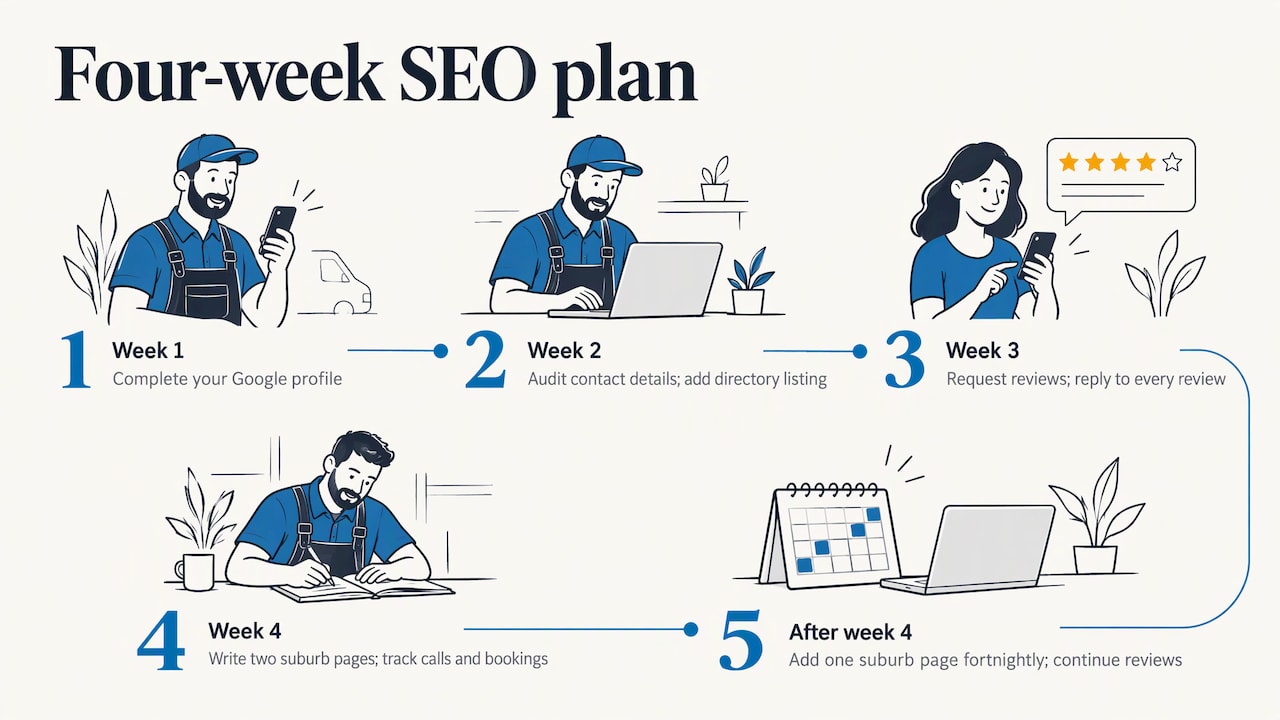
After that, add one suburb page a fortnight and keep the review routine going. It is not glamorous, but it compounds.
FAQ
Can a tradie do local SEO without an agency?
Yes. The core work, a complete Google profile, a review habit, suburb pages built from real jobs and consistent listings, is something an owner can do in a few hours a month. Start with the profile and the review routine, because they have the biggest effect for the least effort.
How long does local SEO take to work?
Profile improvements can be noticed within weeks. Review volume, suburb pages and citation clean-up build over several months, so judge results over a quarter or more rather than week to week. Measure calls and booked jobs rather than ranking position alone.
Do I need a website, or is a Google profile enough?
A profile alone can bring calls, but a website gives you suburb pages, job photos and a place to show proof of your work. It also gives Google more to match against specific services and areas. Even a simple site with a page per main service and suburb is a solid start.
How many reviews do I need?
There is no magic number. Recent, detailed reviews that name the job and the suburb are worth more than a large pile of generic ones. Aim to ask every happy customer, and reply to each review you receive.
Is a directory listing worth it for a sole trader?
It can be. A listing adds a credible, consistent profile that customers can find outside Google, and our Basic plan is $99 per year. Because we select listings on verified credentials and reputation, being listed signals that your business meets a standard.
Sources