The safest way to choose a pest control company is to verify three things before you compare prices: the technician holds a current licence for your state, the business carries the right insurance, and the quote is in writing and says exactly what will be done. A shortlist of verified local providers makes that first step quicker. Our pest control directory lists only businesses selected on verified credentials, reputation and service performance, and it is free for homeowners to use.
This guide walks you through the checks in the order you would do them, and where each one tends to go wrong.
TL;DR
- Pest control is a licensed trade in every state. Look up the technician’s licence on the official register, and make sure its authorisation matches the job (termites are a separate category in Victoria, for example).
- Get several written quotes and compare what is included: inspection, products, follow-up visits and warranty length, not just the headline price.
- Ask for the full chemical name, and tell the company about pregnancy, young children, pets or allergies before work begins.
- Under the Australian Consumer Law, pest control services must be carried out with due care and skill, and a failed treatment can entitle you to a refund or a new treatment.
- Start from a shortlist of verified, independently reviewed local businesses rather than a cold search.
Table of Contents
- Why the choice matters more than it looks
- Step 1: Check the licence, and check it for the right job
- Step 2: Confirm insurance and that the business is solid
- Step 3: Get at least three written quotes
- Step 4: Treat the inspection as part of the test
- Step 5: Compare guarantees, not just prices
- Step 6: Ask the safety questions before work starts
- Step 7: Know your rules for recent changes
- Where a verified shortlist helps
- For pest control businesses: be the name on the shortlist
- A one-page checklist to take to the phone call
- FAQ
- Sources
Why the choice matters more than it looks
A pest treatment puts pesticides in the place where you sleep, cook and where children play. Termite work can also decide whether a house is protected or slowly damaged for years. Both reasons make this a job where a licence and a clear written scope matter more than the cheapest price on the phone.
The good news is that the rules give you plenty to check. State health and environment agencies publish public registers and consumer guides, and they all point to the same short list of questions. The sections below turn them into a routine.
Step 1: Check the licence, and check it for the right job
Licensing is run by each state or territory, so the register you use depends on where you live.
- New South Wales: a person doing prescribed pesticide work must hold an EPA licence. The EPA says to ask to see the photo licence card before agreeing to work, check that the photo matches the person and that the expiry date has not passed, and call the 24/7 Environment Line on 131 555 if you cannot verify it. You can also search the public register by name or licence number. Serious cases of unlicensed work can be prosecuted, with a maximum penalty of $60,000 (NSW EPA).
- Victoria: the Department of Health runs a searchable register of current licence holders with names and expiry dates. There are two licence statuses (fully qualified technician and trainee working under supervision) and four authorisations: general excluding timber pests, general including timber pests, pest animal, and fumigant. Check that the authorisation matches your job (health.vic.gov.au).
- Western Australia: the business must be registered with the Department of Health and treatments must be done by a licensed pest management technician. Ask for the business registration number, which should be displayed on the vehicle, and verify it on (08) 9222 2000 or at ehinfo@health.wa.gov.au.
- South Australia: use the licence look-up tables to find a licensed pest controller, and verify the named technicians’ licences and endorsements (SA Health).
Where it goes wrong: people check that the business has a licence number on its website, but not that the person who turns up is the licensed technician, or that the licence covers the work. A general pest licence is not necessarily a licence for timber pests. Write down the technician’s name, licence number and expiry date, which is also the advice of the Australian Pest Control Association for termite work.
Step 2: Confirm insurance and that the business is solid
A licence tells you the person is qualified. Insurance tells you what happens if something goes wrong. Victoria’s Better Health Channel recommends checking that the operator has enough insurance before you engage them (Better Health Channel). For termite inspections and treatment, APCA advises confirming the company carries both professional indemnity and public liability insurance covering that work (APCA).
SA Health also suggests confirming it is a genuine company: a legitimate street address, a written quote, and an invoice in the same name as the quote. A mismatch between the quote and the invoice name is worth asking about before you pay.
Step 3: Get at least three written quotes
Both Victorian and South Australian health guidance recommend several quotes so you can compare costs, services, products and techniques. WA Consumer Protection adds two practical points: get terms in writing, and find out whether the price is an estimate or a firm quote. If the company offers a yearly contract, read the terms carefully (WA Consumer Protection).
A useful written quote should contain:
- the technician’s contact details, address, licence details and ABN
- terms and conditions where possible
- which areas will be treated and which will be avoided
- what chemicals will be used, why they suit your problem and how they will be applied
- what you need to do before the treatment
- whether you will receive a post-treatment report
That list comes from the WA Health guide. Use it as a template whichever state you live in. If one quote is a single line with a price, you cannot compare it with a quote that spells all of this out.
A quick comparison grid
When the quotes arrive, line them up like this:
| What to compare | Quote A | Quote B | Quote C |
|---|---|---|---|
| Licence and authorisation checked on the register | |||
| Insurance confirmed | |||
| Inspection included and reported in writing | |||
| Products named | |||
| Follow-up visits included | |||
| Warranty length and conditions | |||
| Estimate or firm price |
A gap in any row is a question to put back to the company before you decide.
Step 4: Treat the inspection as part of the test
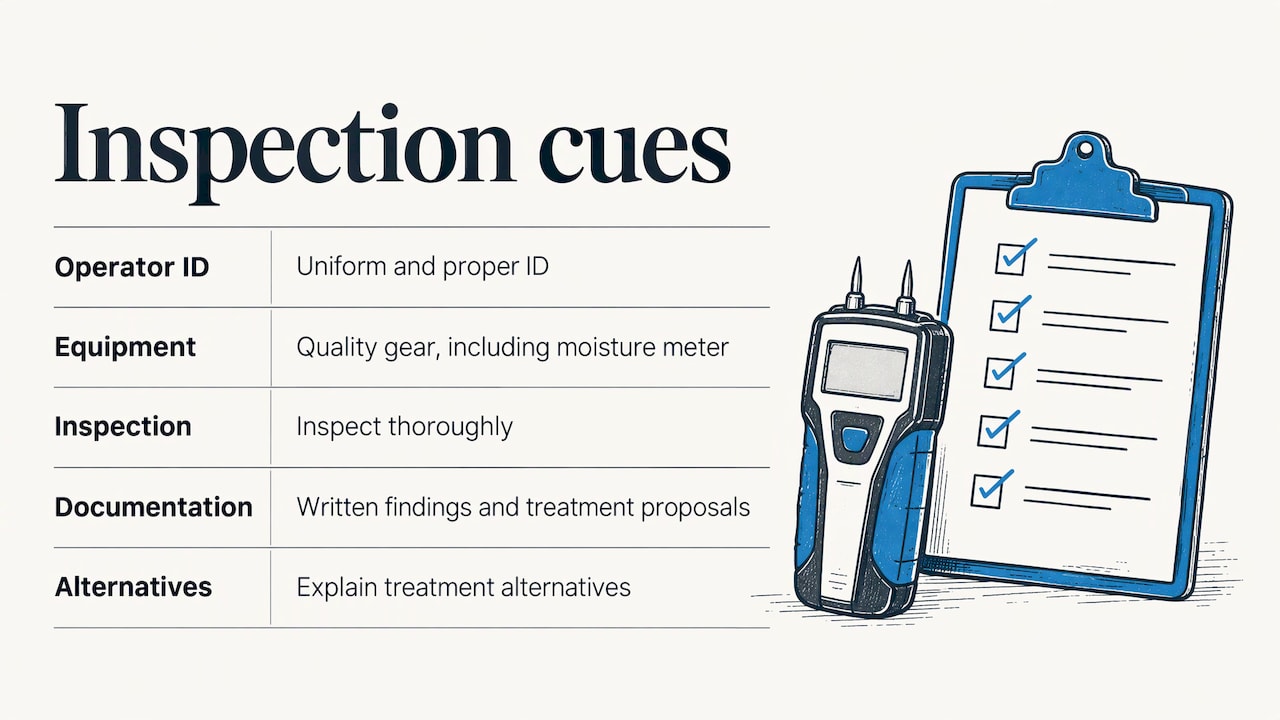
For termites especially, the inspection is the diagnosis, and APCA suggests being there for it. Notice whether the inspector wears a uniform and carries proper ID, uses quality equipment including a moisture meter, inspects thoroughly, presents clear documentation of findings and treatment proposals, and explains the alternatives. Those cues show whether the person knows the subject.
SA Health also suggests asking for references and a written inspection report with a treatment plan. A company that is happy to put its findings on paper is giving you something to hold it to later.
Step 5: Compare guarantees, not just prices
Two quotes can carry the same price and very different protection. Ask what the warranty covers, how long it lasts, whether return visits are free and what conditions apply (for example, that you do not disturb a barrier or that you pay for annual inspections).
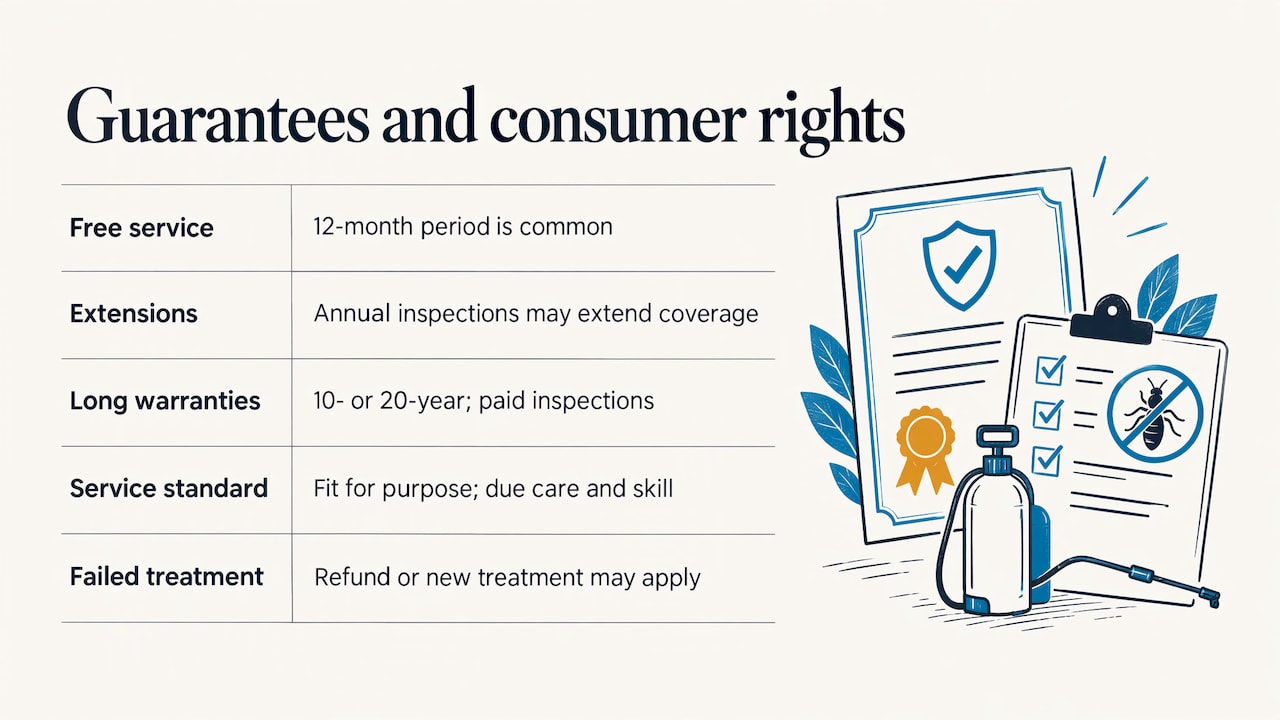
APCA notes that a 12-month free service period on a chemical soil barrier is common, and that it can often be extended each year with regular inspections. It also cautions that 10 or 20 year warranties commit you to paid inspections and other work, and are often unrealistic. Read the fine print on any long-term promise.
Your consumer rights apply as well. WA Consumer Protection explains that the Australian Consumer Law guarantees apply to pest control: services must be fit for purpose and carried out with due care and skill. A company can be liable for property damage it causes, and if a recommended treatment does not work you may be entitled to a refund or a new treatment. If a dispute cannot be settled with the company, your state’s consumer protection or fair trading agency is the next step.
Worked example
You have cockroaches in a three-bedroom house. Quote A is a flat price for a single surface spray. Quote B costs more but includes a written inspection, names the products, includes a follow-up visit and states a warranty period in writing. If the spray in Quote A does not solve it, you pay for a second visit, and the price gap can close quickly. Quote B may be the lower total cost, and it gives you a document to point to if the problem returns. Compare on the rows of the grid, then on the price.
Step 6: Ask the safety questions before work starts
This is where good operators stand out. Better Health Channel says a good operator will listen to concerns about pregnancy, young children or allergies before starting and choose the most appropriate method. Raise them when you book, not when the technician is at the door. SA Health likewise recommends discussing allergies, sensitivities and the ages of occupants, and asking what to expect and what precautions to take during and after treatment.
The Better Health Channel guidance covers the practical routine:
- Ask for the full chemical name of the pesticide, so first aid can be given in an emergency.
- Cover or remove food, clothes, toys, toothbrushes, bedding, towels, vegetable gardens, barbeques, pet bowls, fish ponds, clotheslines and cooking utensils.
- Move pets away during treatment, until the pesticide is dry.
- Close doors and windows for outdoor application.
- Leave the premises while the pesticide is mixed and applied. Four to six hours is generally recommended, but the operator will advise the right time for your treatment.
- After indoor treatment, clean benchtops and utensils before preparing food, and open all doors and windows for a few hours.
Product labels back this up. One registered product label states that people and pests should stay out of treated areas until the spray has dried, and that food, utensils and preparation surfaces should be kept clear of contact (APVMA label). For a poisoning emergency, call the Poisons Information Centre on 13 11 26, or triple zero if someone is seriously unwell.
If anyone in the household is pregnant, very young, elderly or has asthma or allergies, tell the company and your doctor or pharmacist before treatment, and follow the operator’s return-to-home advice for your specific job.
Step 7: Know your rules for recent changes
Rules shift, so check your own state’s current requirements on its official page. As one example, Western Australian guidance now covers follow-up treatment after roof void rodent baiting. Ask a Perth operator what applies to your job and what it costs. For anything you are unsure about, WA Health lists the agencies that handle pesticide enquiries and complaints: the Department of Health, Consumer Protection, the Department of Primary Industries and Regional Development, and the Australian Pesticides and Veterinary Medicines Authority.
Where a verified shortlist helps
The checks above take time, and the first problem is knowing which businesses are worth quoting. That is what a curated directory is for. Business In Focus lists local businesses chosen on verified credentials, reputation and service performance, and quality cannot be bought through promotions. Each listing is a professionally written profile, backed by independent reviews and advice for consumers.
To see providers in your area, start with the pest control directory. If you are in a capital city, there are dedicated pages for pest control in Sydney and pest control in Brisbane. You can also browse every category through our service listings. Then run each name through the licence register, insurance and written quote steps in this guide.
For pest control businesses: be the name on the shortlist
If you run a pest control business, the same buyers are reading this page. They check licences, ask for written scopes and compare guarantees, so a profile that shows your credentials and reputation clearly is what they are looking for. Our listings are professionally written feature pages, sold as annual plans:
- Basic: $99 per year
- Pro: $199 per year
- Agency: $449 per year

You can compare the plans and add your business on the listing plans page. For background on how listings work, see our guide to directory listing pricing in Australia.
A one-page checklist to take to the phone call
- Which state licence and authorisation does the technician hold, and what is the number?
- What is the business registration or ABN, and does the address match the quote?
- Which insurance do you carry for this work?
- Will you give me a written inspection report and a treatment plan?
- What products will you use, what is the full chemical name, and why are they suited to my pest?
- Is the price a firm quote or an estimate?
- What does the warranty cover, for how long, and what are the conditions?
- How long should we stay out, and what should we cover or move?
- What can I do to stop the problem coming back?
A company that answers these quickly and in writing is behaving like the professional guidance says it should.
FAQ
How do I check whether a pest controller is licensed?
Use your state or territory’s official register or enquiry line: the NSW EPA public register, the Victorian Department of Health register, WA Department of Health registration checks or the SA Health look-up tables. Ask to see the technician’s photo licence card and confirm that the name, expiry date and authorisation match the work.
Should I just choose the cheapest quote?
Compare what is included first. A written inspection, named products, follow-up visits and a clear warranty are worth more than a lower headline price. WA Consumer Protection also advises checking whether the price is an estimate or a firm quote.
Is pest control safe with children and pets?
With a licensed technician, registered products and the right preparation, yes. Tell the company about young children, pregnancy, allergies and pets when you book. Keep people and pets out of treated areas until the spray has dried, and cover or remove food and bowls, as Better Health Channel advises.
What can I do if the treatment does not work?
The Australian Consumer Law requires pest control services to be fit for purpose and carried out with due care and skill. If a recommended treatment fails, you may be entitled to a refund or a new treatment. Start with the written warranty, then raise it with the company. If that fails, contact your state’s consumer protection or fair trading agency.
Sources
- NSW EPA: Engaging a pest management technician
- Victorian Department of Health: Find a licensed pest control operator
- WA Health: How to choose a pest management business
- SA Health: Engaging a licensed pest control business
- Better Health Channel: Pest control services
- Australian Pest Control Association: Consumer advice
- WA Consumer Protection: Tips for hiring a pest controller
- APVMA product label