To check whether an Australian business is legitimate, confirm who it is on ABN Lookup and the ASIC registers, confirm its licence with the authority that issues it, then test its address, website and reviews against independent sources. The first two steps are quick and free. They only prove the business exists, though. They do not prove it does good work. That is why we list only businesses selected on verified credentials, reputation and service performance, so the groundwork is done before you pick up the phone.
This guide is for homeowners hiring a tradie or cleaner, and for small business owners and entrepreneurs vetting a supplier, agency or partner.
TL;DR
- Look the business up by name, ABN or ACN on ABN Lookup, and make sure the name and number match what it gave you.
- Check the licence with the relevant state or territory authority. Licences vary by trade and by state.
- Registration is a starting point only. The ACCC notes that numbers and licences can be faked and do not guarantee trustworthiness.
- Compare reviews, address, phone and website across independent sources, and treat sudden review spikes and generic comments as red flags.
- If anything is off, stop and do not hand over personal details. If you have been caught out, contact your bank first, then report to Scamwatch.
Table of Contents
- Why registration alone is not enough
- Step 1: Confirm who they are on ABN Lookup
- Step 2: Check the company and business name on ASIC
- Step 3: Check the licence with the issuing authority
- Step 4: Test the address, phone and website
- Step 5: Check reputation and spot fake reviews
- Step 6: Know the warning signs of a scam
- What to do if a business fails the checks
- Skip most of the legwork: start from a vetted list
- For business owners: make your legitimacy easy to check
- FAQ
- Sources
Why registration alone is not enough
Most searches for this topic end at the same place: the government registers. That is the right place to start. The ACCC’s guidance on checking a business is genuine points to the ASIC and ABR searches, licence checks, the business’s address and website, and reviews from several sources. It also says that registrations and licences are a good start but do not guarantee trustworthiness, and that registration numbers and other identification can be faked.
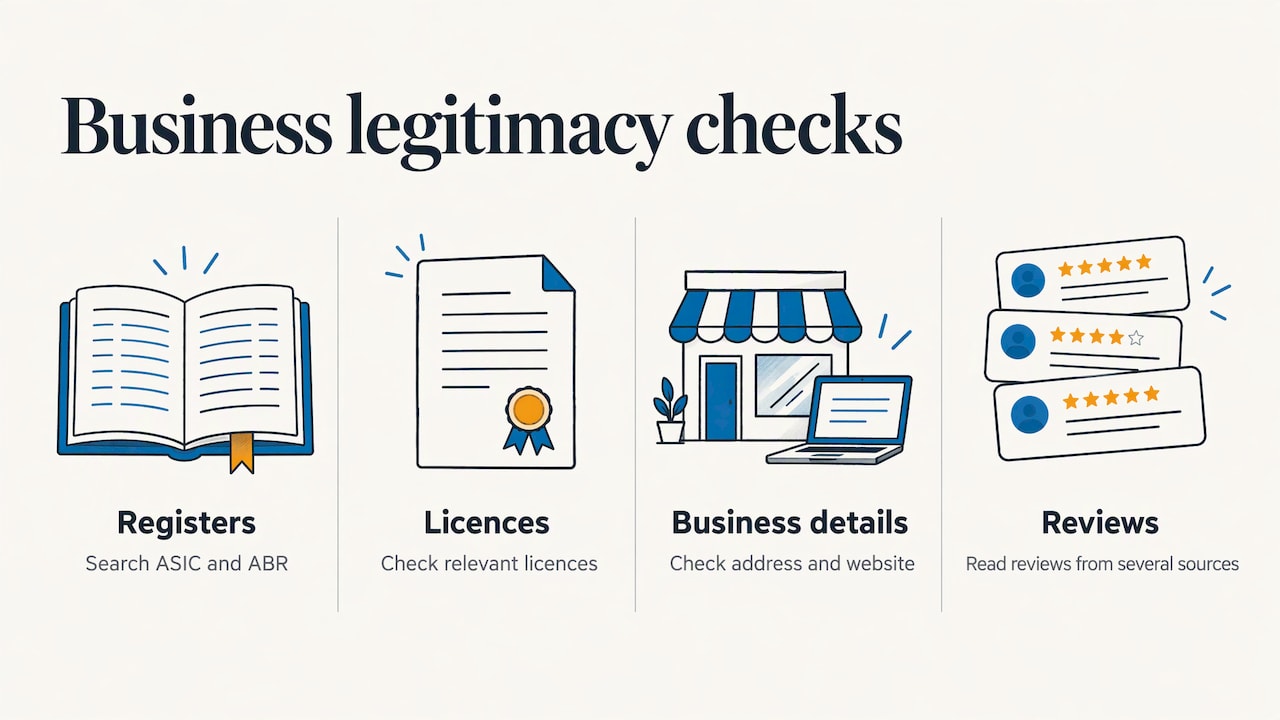
So the job has two halves. First, prove the business is who it says it is. Second, find out whether real customers have been happy. The registers answer the first. Reviews, referrals and a curated source answer the second.
Step 1: Confirm who they are on ABN Lookup
An Australian Business Number (ABN) is the 11-digit number businesses use to identify themselves to the government and to customers. Ask for it, then search it on ABN Lookup, the official free search run by the Australian Government.
What to do:
- Search by business name, ABN or ACN (the 9-digit number given to a registered company).
- Check the ABN status is active and the entity name matches the name on the quote, invoice or website.
- Check the location shown. The ABN Lookup FAQs say the search shows ABN status, entity and business names, the business location by postcode, GST registration and some other registrations.
Where it goes wrong:
- Mismatches. ASIC’s guide, Check another business is trustworthy, recommends matching the operating name and the ABN or ACN against ABN Lookup, and treating missing or mismatched details as warning signs.
- Out-of-date entries. ABN Lookup receives updates from the Australian Business Register hourly, but the FAQ states the information may not be accurate, current or complete, because businesses must update their own details.
- Old trading names. According to the ABN Lookup names FAQ, trading names stopped being collected or updated in May 2012. Historical trading names shown there have no legal status and should not be used to establish identity.
Sole traders often trade under their own name. The ACCC explains that people trading under their personal name do not need a separate business name registration, and usually have an ABN. A tradie with an ABN under their own name is not suspicious. A “company” with a name that appears nowhere is.
Step 2: Check the company and business name on ASIC
If the business is a company, the ASIC companies register tells you more than ABN Lookup does. ASIC’s guide recommends checking registration and external administration status. External administration usually means the company is insolvent, which matters if you are about to pay a deposit or sign a supply contract.
A company extract also shows the current directors and how long they have been with the company. ASIC says frequent director changes may be a warning sign.
For a trading name, use ASIC’s business names register to find who owns or operates the registered name. That is how you find out whether “Bright Spark Services” is the same entity as the one on the invoice. Business names generally need to be registered with ASIC, according to the ACCC.
A worked example: a cleaner quotes under a trading name and gives an ABN. ABN Lookup shows the ABN belongs to a different individual, and the business name search shows the trading name registered to someone else again. Nothing here is proof of fraud, but you now have a question the business must answer before you pay anything.
Step 3: Check the licence with the issuing authority
An ABN is not a licence. Plumbing, electrical work, building and many other trades need a licence or permit, and the rules differ by state and territory. The ACCC recommends verifying any claimed authorisation with the relevant licensing authority, or checking business.gov.au for the permits that apply.
The licence number on a business card or website is the claim. The licensing authority’s register is the proof. For example, South Australia’s Consumer and Business Services home-building guide, dated January 2025, advises checking that the builder holds a current Building Work Contractor’s Licence and that the supervisor holds the required Supervisor’s Registration. Other states have their own regulators and register names, so search for your state’s licensing body for the trade you are hiring.
Check three things on the register:
- The licence is current, not expired or suspended.
- The licence class covers the work you want done.
- The name on the licence matches the person or company you are dealing with.
For financial services, Moneysmart says licence details a business states should be confirmed in ASIC’s Professional Registers Search.
Step 4: Test the address, phone and website
A real business leaves traces in more than one place. The Queensland Government’s guide to knowing if a business is legitimate recommends checking a physical address and a landline, searching the Business Names Register, asking friends and family, and looking for independent testimonials and local reputation.
Moneysmart’s guidance on scam websites adds that a site’s address, phone, email and social accounts should be compared with independent sources. Inconsistent contact details, or contact channels that are anonymous only, warrant caution.
A quick routine:
- Does the address exist, and does it match the ABN Lookup postcode?
- Does the phone number connect to someone who answers in the business’s name?
- Does the website address match the business name exactly? The ACCC lists a lookalike web address as a warning sign.
- Do the social accounts have a history, or were they created recently?
ASIC’s scam guidance says information supplied by a business should be verified independently, not accepted from an email or phone call. If a business sends you its own “verification” link or licence photo, look it up yourself on the register instead.
Step 5: Check reputation and spot fake reviews
Registration says a business exists. Reputation says whether it is any good. The ACCC advises reading reviews from multiple sources and seeking referrals from someone you trust.
It also lists the signs that reviews may be fake:
- a sudden spike of reviews in a short period
- generic comments that could apply to any business
- reviewers with similar names
- repeated language across reviews
A useful habit is to read the three-star reviews first. They tend to describe the actual job, including how problems were handled, and they are harder to fake. Then check whether the business replies to complaints. A calm, specific reply tells you more than a perfect rating does.
For a hands-on job, ask for a past customer in your suburb or a similar job. Local reputation is one of the checks the Queensland Government recommends.
Step 6: Know the warning signs of a scam
The ACCC lists these signs:
- fake registration numbers or licences
- a lookalike website address
- unusual payment methods
- requests for personal information before any information about the business is available
- offers that seem too good to be true
Its advice is simple: if you are unsure, do not buy and do not share personal information. A business that pushes you to pay a large deposit in advance, by a method you cannot reverse, before you have seen a licence is telling you something.
For a bigger commitment, such as a major renovation, a supply contract or a payment to an agency, Justice Connect’s guide to checking a company is real, last updated 28 November 2025, is written to help people check a business before giving it money and spot warning signs.
What to do if a business fails the checks
If the details do not add up, stop. Do not share more personal information and do not pay.
If you have already been targeted, the ACCC’s business scams page says to contact your bank immediately, seek support from IDCARE, and report the scam to Scamwatch. Scamwatch reports help identify and disrupt scams, but Scamwatch does not recover lost money. That is why the bank call comes first: it is the step that can act on a payment.
Skip most of the legwork: start from a vetted list
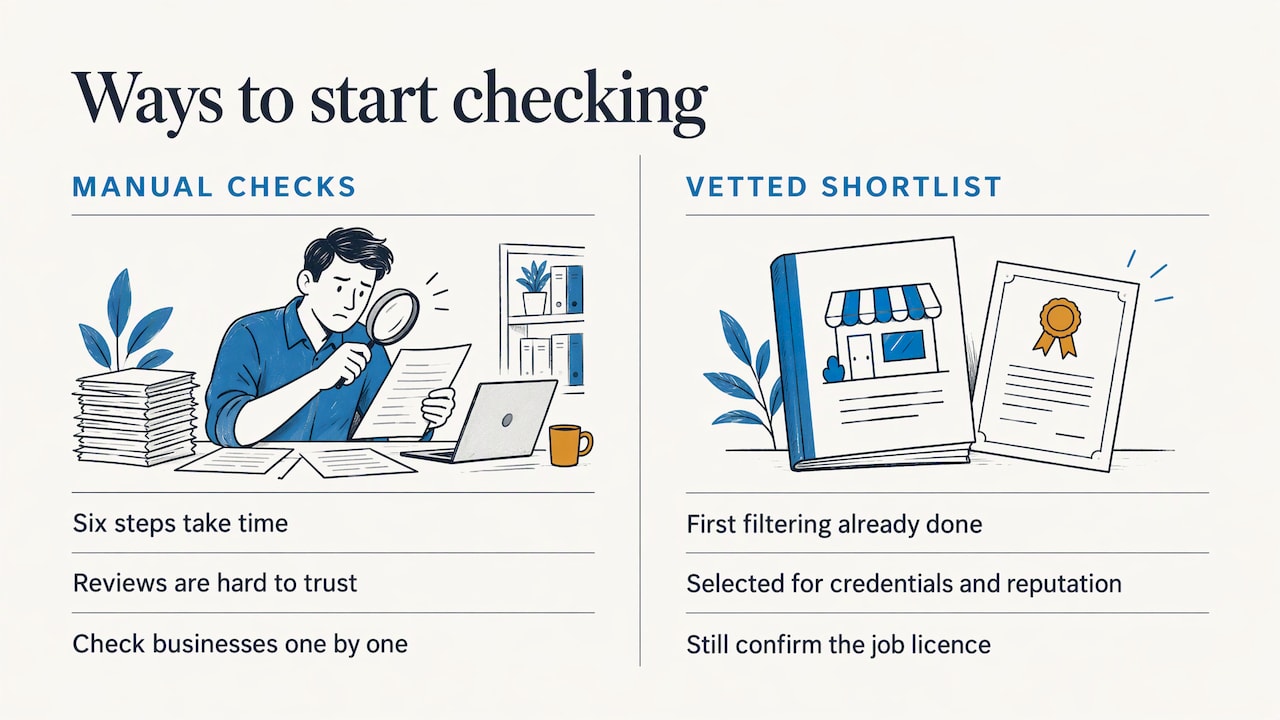
The six steps above work, and for a major job they are worth doing. They also take time, and they still leave you reading reviews you cannot fully trust. The easier route is to begin with a shortlist where the first filtering is already done.
Business In Focus is a curated directory of verified, high-performing Australian local businesses, across plumbing, electrical, cleaning, chiropractic, pest control and more. Each listing is selected on verified credentials, reputation and service performance, and our selection favours quality over paid promotion. Each business profile is professionally written and reviewed, so you get a substantial picture of the business, not just a name and phone number.
Here is how that fits with the steps. You still confirm the licence for the job you are booking, because that is your protection, but you begin with businesses that have already been through selection. Browse our service listings, or go straight to a category such as plumbers or electricians. Our guide to getting verified online in Australia explains identity and business verification in more depth, and our advice on finding a dependable handyman applies the same thinking to a common job.
For business owners: make your legitimacy easy to check
The checks above are what your customers are doing to you. Keep your ABN Lookup entry current, display your licence number, keep contact details consistent across your website and social accounts, and respond to reviews professionally. Our guide on responding to bad reviews covers the last part, and our piece on using online business listings well covers the rest.
If you want a professionally written feature page in a directory that selects on quality, our annual plans are Basic at $99 per year, Pro at $199 per year and Agency at $449 per year. Compare them on the add your business page.
FAQ
How do I check if a business is legitimate in Australia?
Search the business on ABN Lookup by name, ABN or ACN, and confirm the name matches. For companies, check ASIC’s register for status and directors. Then confirm any required licence with the state or territory authority and compare reviews from several sources.
Is an ABN proof that a business is legitimate?
No. An ABN shows the business is registered, not that it is licensed, skilled or honest. The ACCC says registrations and licences are a good start but do not guarantee trustworthiness, and numbers can be faked, so always look the number up yourself.
How can I tell if online reviews are fake?
The ACCC lists sudden spikes of reviews, generic comments, similar reviewer names and repeated language as signs. Read reviews across more than one source and ask someone you trust for a referral.
What should I do if I think a business is a scam?
Do not pay or share personal information. If you have already lost money or details, contact your bank immediately, seek support from IDCARE and report it to Scamwatch. Scamwatch does not recover lost money, so the bank is the first call.
Sources
- Checking a business is genuine, ACCC
- Check another business is trustworthy, ASIC
- ABN Lookup FAQs
- Business names/Trading names FAQs, ABN Lookup
- Building, Extending and Renovating a home, Consumer and Business Services SA
- How to spot a scam website, Moneysmart
- Knowing if a business is legitimate, Queensland Government
- How to check if a company is real before giving them money, Justice Connect
- Business scams, ACCC