The fastest way to find a licensed electrician is to start with a curated list of businesses that have already been checked, then confirm the licence yourself on your state or territory register before anyone touches your wiring. Our electrician directory is built for the first step: every listing is selected on verified credentials, reputation and service performance, and a place cannot be bought through promotions. This guide covers the second step, which is the same wherever you live: know which register to search, what the licence should show, and what paperwork you should receive when the job is done.
TL;DR
- Electrical work in Australia is licensed by state and territory, so the register you check depends on where the job is.
- Search the official register by licensee name, licence number or location, and ask to see the licence or ID card on the day.
- A licensed electrician should issue a certificate of compliance for the work (in Victoria, a Certificate of Electrical Safety).
- Ask about past projects, who supervises the work and how problems were fixed, and read how the business replies to negative reviews.
- Start with a curated list of verified electricians, then confirm the licence on the official register.
Table of Contents
- Why the licence matters for home electrical work
- Step 1: Build a shortlist from listings you can trust
- Step 2: Check the licence on your state or territory register
- Step 3: Ask for the licence or ID card on the day
- Step 4: Compare quotes with the right questions
- Step 5: Get the certificate when the job is done
- A quick worked example
- Warning signs to act on
- For electricians: getting found by homeowners
- Get listed on Business In Focus
- FAQ
- Sources
Why the licence matters for home electrical work
Electrical work is not like painting or tiling. Mistakes in wiring can stay hidden for years, then show up as a tripped safety switch, a failed appliance or a fire. That is why every state and territory restricts who can do it.
Energy Safe Victoria says doing your own electrical work is illegal and extremely dangerous, even for small jobs like changing power points or light switches. In Western Australia, work on systems above 50 volts AC or 120 volts DC can only be done by people licensed by the Electrical Licensing Board. To get that licence, an electrician must be a fit and proper person (including a police check), have completed an approved apprenticeship or equivalent training, and pass the required examinations.
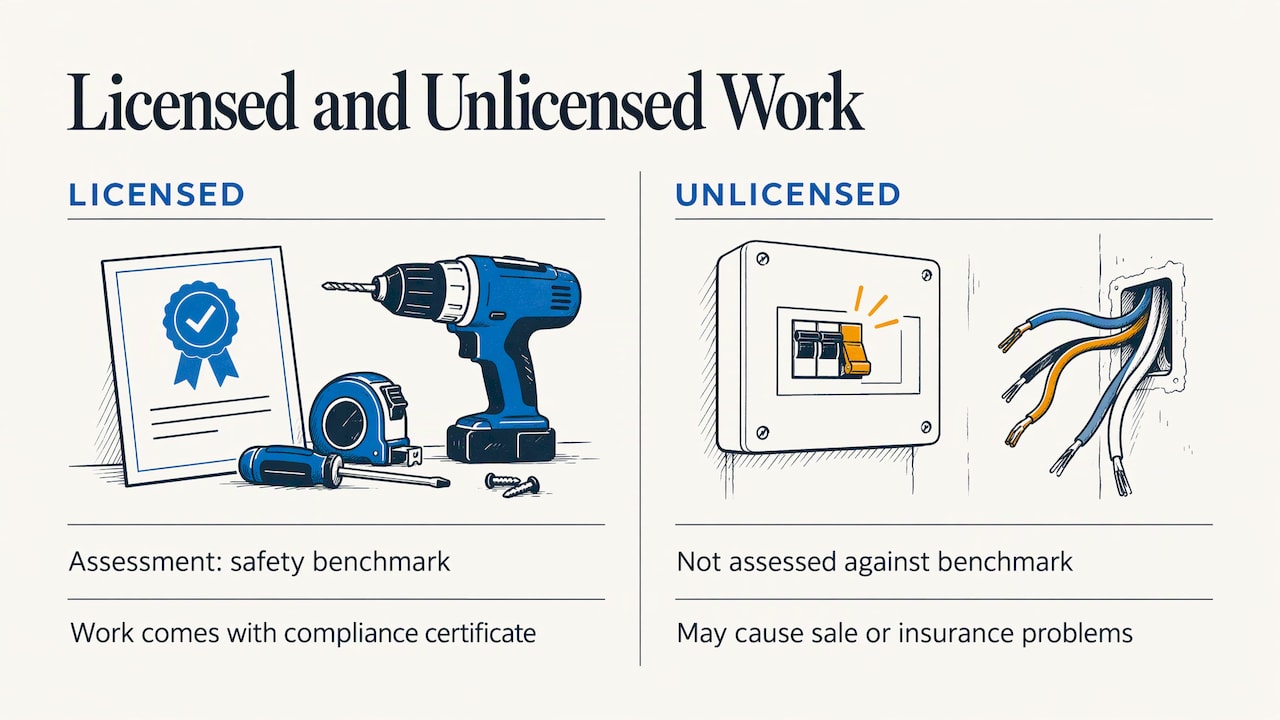
Behind the state rules sits a national standard. The Electrical Regulatory Authorities Council publishes Essential Performance Capabilities for Electricians, which set out what an electrician must demonstrate before an unrestricted licence is issued in any state or territory, including critical safety components in a final assessment. In plain terms, a current licence means the person has been assessed against a safety benchmark. An unlicensed worker has not.
If you are a homeowner or landlord, this also protects you in practical ways: licensed work comes with a compliance certificate, and unlicensed work can leave you with a problem when you sell, claim on insurance or need the job redone.
Step 1: Build a shortlist from listings you can trust
Searching “electrician near me” returns a long list of ads, and many businesses can look the same at first glance. A shortlist works better when it comes from a place that has already screened for credentials and reputation.
That is how we run our directory. Listings are selected on verified credentials, reputation and service performance rather than paid promotion, and each featured business has a professionally written profile with independent reviews. You can browse by area:
To see what a full profile looks like, read the review of The Local Electrician. Pick two or three businesses that service your suburb and handle your type of job, whether that is a switchboard upgrade, new power points, lighting or fault finding.
If you are not sure what kind of job you have, our guide to common electrical faults in homes and when to call an electrician helps you describe the problem clearly, which makes quotes easier to compare.
Step 2: Check the licence on your state or territory register
A listing tells you where to start. The official register tells you whether the licence is current. Do this for every business on your shortlist, using the register for the state where the work is done.
New South Wales
Service NSW lets you check a tradesperson’s licence online using the licensee name, licence number, licence type, ABN, ACN or location (suburb, postcode or local government area). A licence is required for wiring work in NSW, and digital licences can be checked in the Service NSW app. The NSW Government’s guide to choosing a tradesperson also points you to the Verify NSW website and to industry association websites that list licensed members.
Victoria
In Victoria you must use a registered electrical contractor (REC) for electrical installation work. Energy Safe Victoria says there are around 45,000 active licensed electricians or RECs in the state, and it runs a free Public Register of RECs you can search. It also advises asking to see the tradesperson’s licence or ID card, and choosing someone who shows their qualifications and areas of expertise in their advertising.
For larger projects, the Victorian building guide notes that most work worth $10,000 or more needs the practitioner to be registered or licensed with the Building and Plumbing Commission. It suggests searching the commission’s register and its disciplinary register before you hire, and, for electrical work, confirming that any subcontractor holds the right registration and can issue a certificate of electrical safety.
Queensland
The QBCC says the easiest way to find a licensed contractor is its free find-a-contractor search, filtered by work type, location and radius, with a licensee register for the full licence history. Licensed contractors must advertise their contractor name and licence number. One detail matters for electrical jobs: the QBCC notes that electrical work requires a licence from the Electrical Safety Office, so a building licence alone is not the right one for wiring.
Western Australia, South Australia, Tasmania, the ACT and the Northern Territory
Each has its own electrical licensing authority and register. In Western Australia, the Electrical Licensing Board sets the requirements described on the state’s electrical licensing page. Wherever you are, use the official government register for that jurisdiction, not a third-party site, and match the name and licence number on the quote with the entry you find.
What to look for on the register
Whichever register you use, three checks take a couple of minutes:
- Name match. The business or person on the quote is the licensee, or employs one.
- Licence type and status. It covers electrical work and is current, not expired or suspended.
- Conditions or history. Where the register shows disciplinary records or conditions, read them.
Step 3: Ask for the licence or ID card on the day
A register confirms that a licence exists. It does not confirm that the person at your door is the licence holder. This is why Energy Safe Victoria’s advice is to always ask to see the licence or ID card of the tradesperson. A professional expects the question and will have the card ready.
It is also worth asking who will actually do the work. Many businesses send an apprentice or a second electrician. The NSW Government’s guide lists asking who will supervise the work among the questions to put to any tradesperson, and it is a fair one for a site where several people may be on the tools.
Step 4: Compare quotes with the right questions
Price matters, but a quote that is much lower than the others is a reason to ask what has been left out. Put the same questions to each business on your shortlist:
- What is the scope: what is included, and what would count as an extra?
- Will you issue a compliance certificate when the work is finished?
- Who will carry out and supervise the work?
- How long will it take, and when can you start?
- What happens if a fault shows up after the job?
The NSW guide suggests asking about previous projects: whether they were finished on time and within budget, and whether defects were addressed promptly. Ask for the answer in specifics, not a general assurance. A business with a long record of local work can usually name a recent job similar to yours.
Read reviews for how problems were handled
Every business gets the odd unhappy customer. The Victorian building guide advises looking at how a practitioner responds to negative reviews, because this shows how they resolve problems and communicate. A calm, specific reply that offers to put things right says more than a page of five-star ratings. Our independent reviews are written to give you that fuller picture of a business before you call.
Step 5: Get the certificate when the job is done
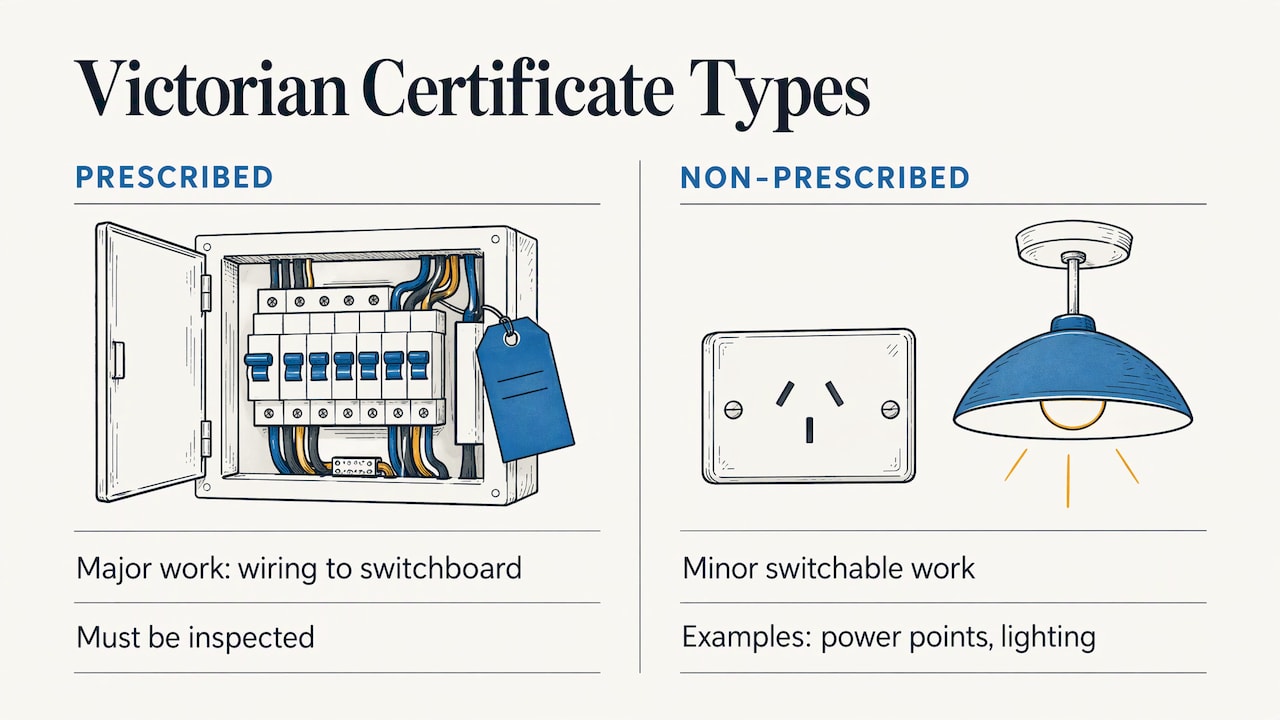
The paperwork is part of the job. In Victoria, a licensed electrician must issue a Certificate of Electrical Safety (COES) after electrical installation work. Energy Safe Victoria explains the two kinds: prescribed certificates cover major work such as wiring up to the switchboard and must be inspected, while non-prescribed certificates cover minor switchable work such as power points and lighting. If a contractor will not show a licence or issue a certificate, Energy Safe Victoria says to contact it immediately.
Other states use different names and forms for their compliance certificates, so ask your electrician what will be lodged or handed over for your job. Keep a copy with your property records. It helps when you sell, when you renovate again and if an insurer asks about past work.
A quick worked example
Say you own a house in Brisbane and want four new power points in a renovated kitchen plus a switchboard check.
- Open the Brisbane electrician listings and choose three businesses that cover your suburb.
- Search each name in the QBCC contractor search or the Electrical Safety Office licence details, and confirm the electrical licence is current. Note that a building licence alone does not cover wiring.
- Request written quotes that name the licence number, list the scope and state that a compliance certificate will be provided.
- On the day, ask to see the electrician’s licence card and who is doing the work.
- After the job, keep the certificate and the invoice together.
That takes under an hour of your time before the work, and it leaves you with a clean paper trail.
Warning signs to act on
These are the points to treat as a stop:
- A business that will not give a licence number, or whose number does not match the register.
- No licence number in its advertising. In Queensland, for example, licensed contractors must advertise their contractor name and licence number.
- A handyperson offering to do electrical work. Handypeople are not licensed for wiring.
- Reluctance to issue a certificate for the completed work.
If you want the same thinking applied to general home jobs, our guide to finding a dependable handyman shows which tasks a handyperson can take on and which need a licensed trade.
For electricians: getting found by homeowners
If you run an electrical business, everything above is what your customers are doing before they call you. They check your licence, read your reviews and look for a profile that shows your work. A clear profile with your licence details, service areas and the kinds of jobs you take helps them reach the decision to book you.
Our listing plans are designed for that. Each business gets a professionally written feature page, selected for verified credentials and reputation, and placed on targeted landing pages. Our guides to using online business listings well and local citations for SEO walk through how a consistent presence across the web supports local visibility.
Get listed on Business In Focus
Businesses on our directory are featured on merit, which is what gives homeowners confidence in the list. Listings are sold as annual plans for sole traders, local businesses and agencies:
- Basic: $99 per year
- Pro: $199 per year
- Agency: $449 per year

See what each plan includes and apply on the add your business page. If you are a homeowner, our directory of trusted local services is free to use.
FAQ
How do I check that an electrician is licensed?
Search the official register in the state or territory where the work will happen, using the licensee name, licence number or business name. In NSW that is the Service NSW licence check, in Victoria the Energy Safe Victoria register of RECs, and in Queensland the QBCC search plus the Electrical Safety Office for electrical licences. On the day, ask to see the licence or ID card.
Do I need a licensed electrician for small jobs like replacing a power point?
Yes. Energy Safe Victoria states that electrical work is not a do-it-yourself job, including small tasks such as changing power points or light switches. A licensed electrician can do it safely and issue the right certificate for the work.
What paperwork should I get after electrical work?
You should receive a compliance certificate for the work. In Victoria it is a Certificate of Electrical Safety, with major work inspected and minor work such as power points and lighting covered by a non-prescribed certificate. Ask your electrician which certificate applies in your state and keep it with your records.
How do I choose between several licensed electricians?
Compare written quotes on scope, timing, who supervises the work and what happens if a defect appears. Ask about similar recent jobs and read how each business replies to criticism in reviews. A shortlist from our electrician listings gives you businesses selected on verified credentials and reputation to compare.
Can a handyman do electrical work?
No, not unless the person holds the relevant electrical licence. Wiring needs a licensed electrician, and the register will show whether the person you are talking to holds one.
Sources
- Electrical workers | Energy Safe Victoria
- Electrical DDIY – Don’t do it yourself | Energy Safe Victoria
- Find a licensed contractor | Queensland Building and Construction Commission
- Check a builder or tradesperson licence | Service NSW
- Step by step guide to choosing the right tradesperson or builder | NSW Government
- Finding a practitioner and getting quotes | Victorian Building Authority
- Electrical licensing | Government of Western Australia
- Essential Performance Capabilities for Electricians | ERAC